
Two European cities have long participated in a lively debate over which hosts the continent’s greatest annual Pride celebration.
Contestant #1 is Madrid, where in recent years up to 2 million celebrants have participated in the weeklong summer festivities. Contestant #2 may come as a surprise. Paris? Rome? Berlin? Nope. Cologne!
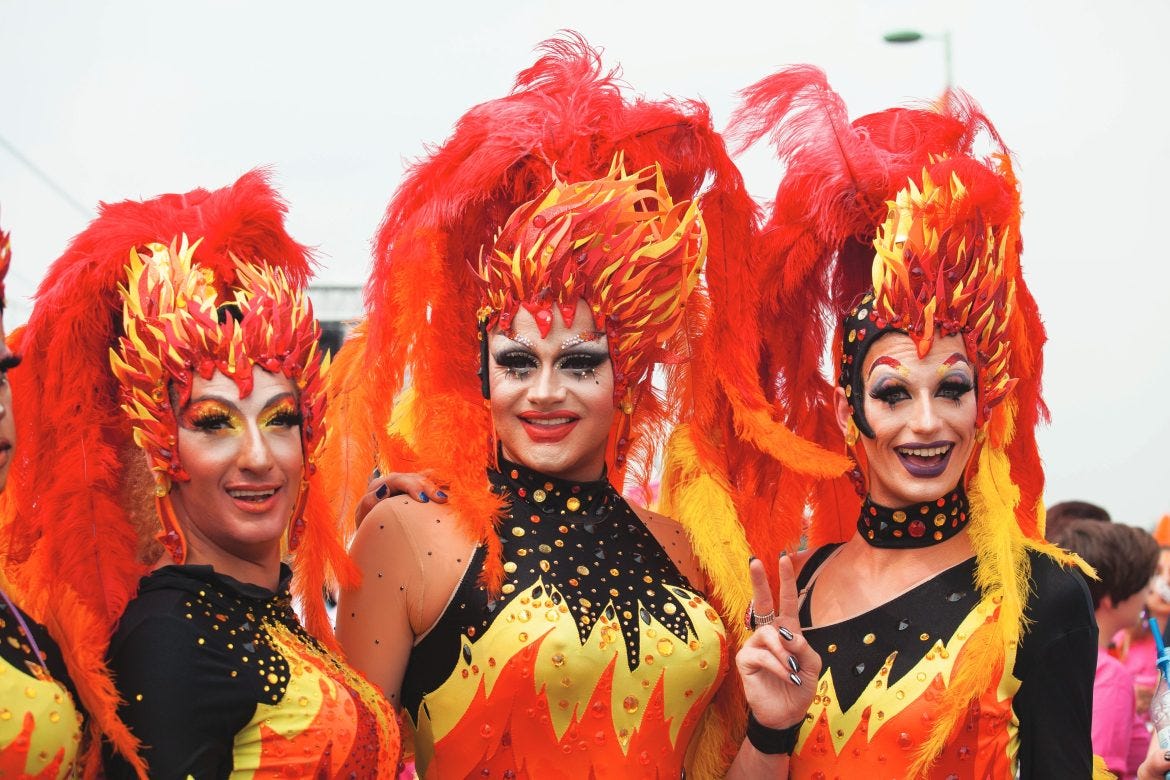
Germany’s fourth largest city, located just east of the Belgian border and known in German as Köln, hosts two full weeks of Pride events beginning in late June and concluding with a three-day festival which draws about 1.5 million revelers to its civic center.
While each of the two rival metropoles makes claims of Pride primacy based on metrics that work to its own advantage, Madrid leans into body count, while in Cologne length matters. It’s ultimately a battle for little more than bragging rights.
Regardless of who’s the champ, many gay Americans already familiar with Madrid will be intrigued to learn that Cologne is even a contender. They may be further surprised to hear that a whopping 10.6% of the city’s population identifies as LGBTQ+.
If this queer-friendly burg on the banks of the Rhine has eluded your gaydar until now, it’s well worth adding to a future itinerary.
A SECOND CELEBRATION
Beyond painting the town pink during the weeks surrounding Pride (which Kölners refer to as Christopher Street Day, or CSD), the city welcomes a raucous gay presence as part of its massive annual Carnival celebration, which holds its own with its kindred pre-Lenten debauches in New Orleans, Rio de Janeiro, and Venice.
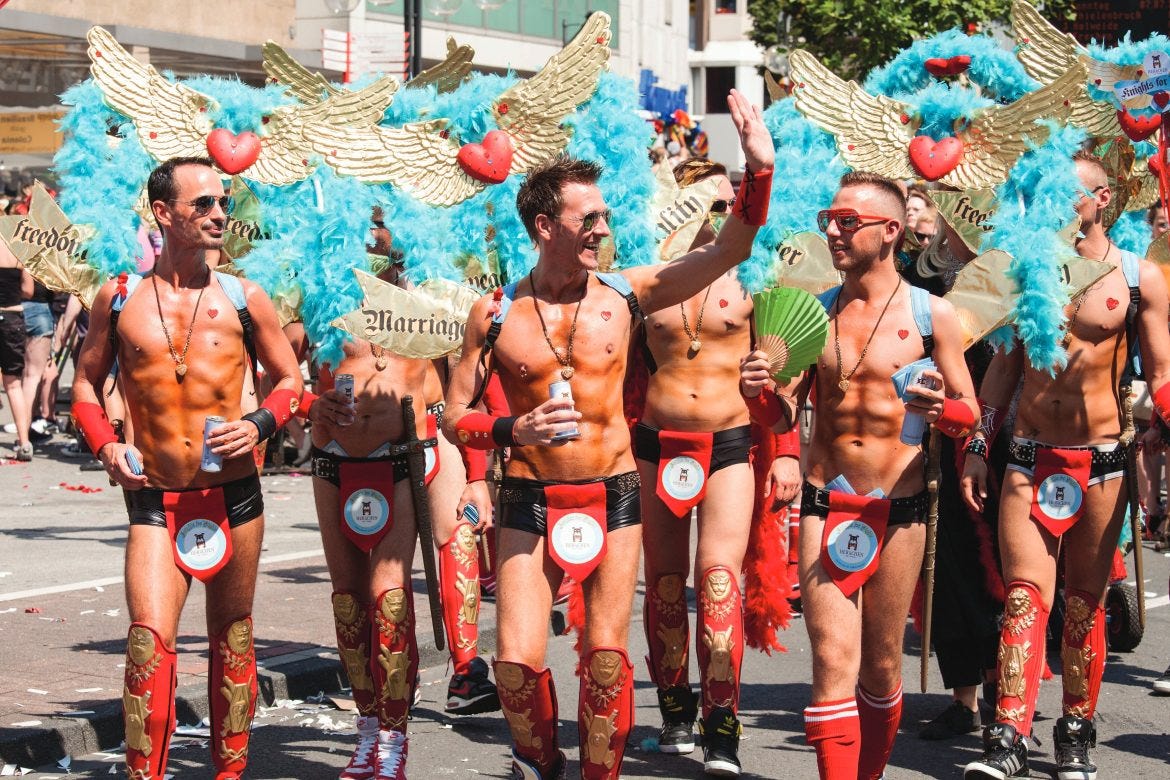
Cologne’s old town is essentially taken over by a six day costume party. The StattGarde Colonia Ahoj, a gay carnival crew fond of sailor suits and other naval gear is omnipresent, spearheading public parades, drag shows, and musical performances daily. Ticketed circuit parties amp up weekend nights even higher, and bars’ closing hours are suspended for the duration. In 2026, the festivities run from February 12–18.
BEST WHEN CHILLED
While annual festival periods offer wild, unfettered fun, part of Cologne’s year-round appeal is that it’s not what I call a “checklist city”– one of the massive, marquee-name world capitals where can’t miss sights and activities are so numerous that you can run yourself ragged and still leave with a nagging sense of FOMO.
It’s a perennially popular long weekend destination for queer Europeans, accessible by train in just a few hours from much of France, Belgium, and the Netherlands, as well as being a regular destination for several of the continent’s budget airlines, including RyanAir and Eurowings.
Among Germany’s most laidback cities, with a marked absence of Teutonic starch, Cologne offers a nice tight portfolio of must do’s that you can tackle over three or four days with ample left time to chill out, wander aimlessly, and soak in the city’s relaxed vibe.
You’ll also have enough energy left to explore the city’s lively year-round gay nightlife, largely clustered around a stretch of Schaafenstrasse with over a dozen busy clubs and watering holes including the always busy ExCorner bar (facebook.com/ExCorner); twinkerrific club Mumu (die-mumu.de) — beware the strong house cocktail, Mumu Juice; and charming elder statesman Schampanja (schampanja-koeln.de), still going strong after 40 years.
A bit further afield are a pair notable of venues specializing in Ger many’s famously sex-positive cruising culture: Babylon (babyloncologne.de), a bathhouse with a handsome outdoor pool area for daytime sunning, and Pullerman’s (pullermans.de), whose website proudly pro claims: “Whether born in 1940 or 1990, whether completely in rubber or completely naked, everything goes.”
UNMISSABLE
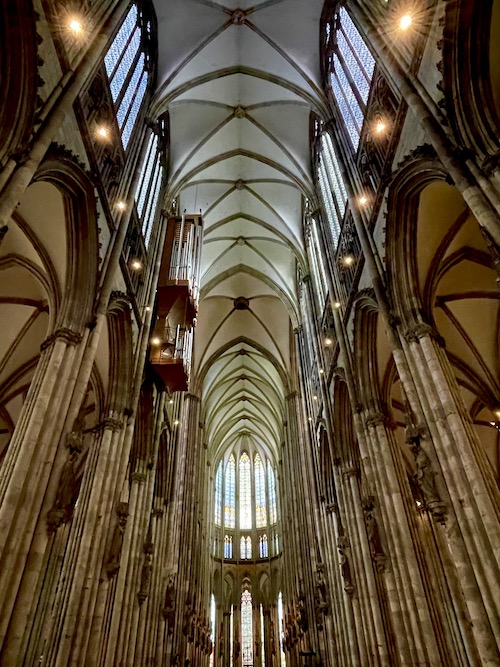
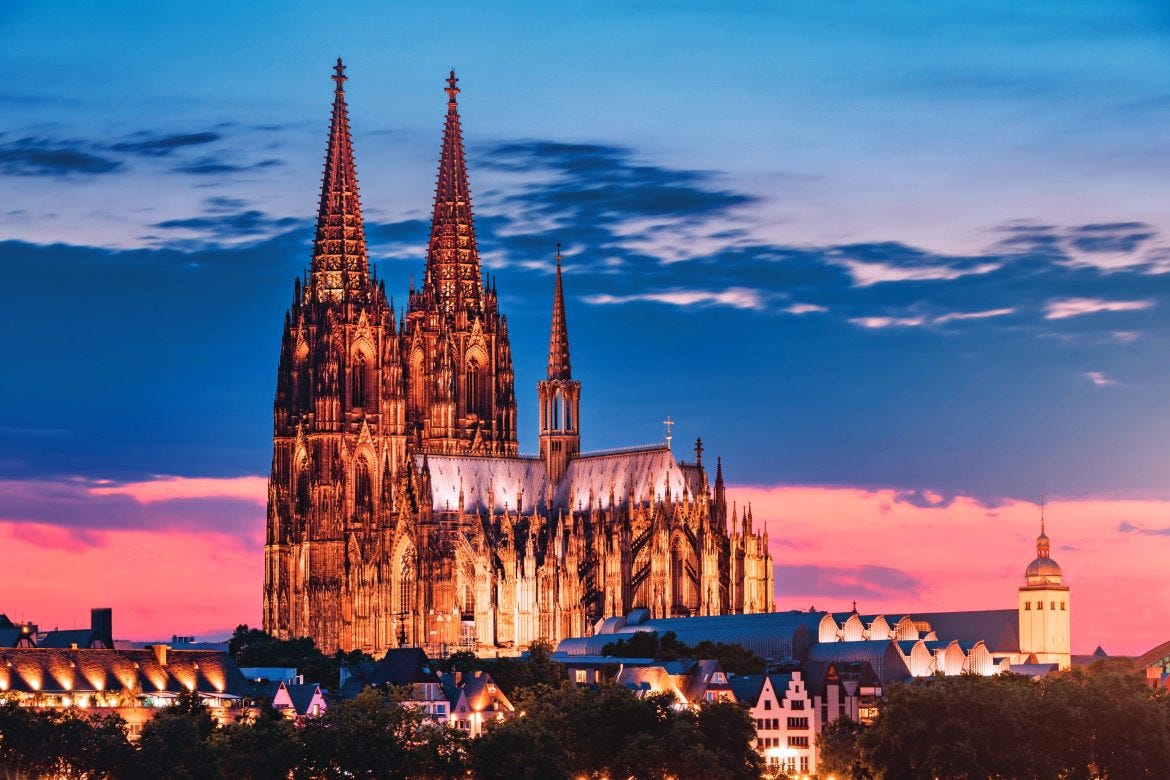
When arriving in Cologne via train there’s no chance you’ll miss the city’s best-known attraction. Adjacent to the station is the Cologne Cathedral (koelner-dom.de), the world’s third tallest church building and the most visited landmark in the entire country of Germany, drawing over 6 million visitors annually.
The cathedral has also served as a symbolic center of the fight for LGBTQ+ rights within organized Catholicism. In September 2023, sever al priests held a ceremony blessing 30 same-sex couples in front of the building, defying the orders of the diocese’s highly conservative archbishop. The action drew press attention internationally, and three months later, Pope Francis authorized such blessings worldwide.
The base of the cathedral occupies more than a full city block. It’s a masterpiece of gothic architecture, with vertical ornamentation and narrow pointed arch windows that lend it a surprising sense of lightness and upward thrust. My eyes zipped up the church’s ornate facade, racing toward the finials of the church’s twin spires.
While the building directs your gaze to heaven in an instant, its con struction was anything but speedy. It began in 1248, then paused for 300 years as the Protestant Reformation swept Europe, before finally being completed in 1880.
During WWII, when most of Cologne was leveled by Allied airstrikes, the cathedral, though damaged, was spared; not only out of respect for the sacred building, but because its high-visibility structure and height made it a valuable navigation guide for pilots. Today, its visual prominence makes it a valuable navigation guide for tourists!
While you’ll no doubt see the cathedral from a distance during much of your time in Cologne, be sure to visit its interior, where you can genuflect (or raise an eyebrow) at a golden shrine alleged to contain the bones of the Three Wise Men, then climb 533 tower stairs to take in a panoramic view of the cityscape along the Rhine.
I was particularly impressed with a nearly 1200 square-foot stained glass window designed, created, and donated in 2007 by Dresden-born Gerhard Richter. Now 93 and widely considered one of the world‘s most important living artists, Richter arranged over 11,000 small glass squares in 72 different colors, to form what appears as a glimmering pixelated grid. It’s a stunning, strikingly modern element amidst the gothic splendor.
OUTSTANDING ARTS COMPLEX
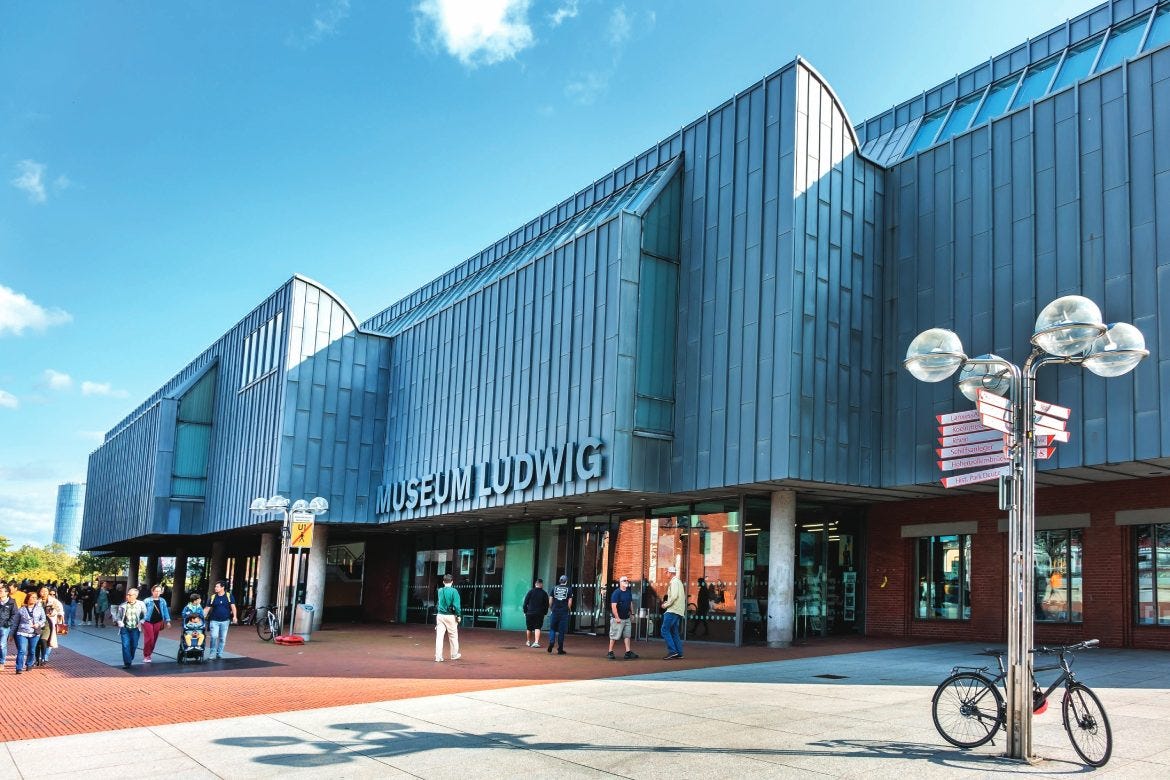
Just a minute’s walk from the cathedral more Richter masterpieces, along with the world’s third largest Picasso collection (over 900 works), and Europe’s most extensive Pop Art collections, can be found in the permanent holdings of the modern Museum Ludwig (museumludwig.de).
With broad, airy galleries and an easily navigable floor plan, the Ludwig feels energizing, as if designed to keep visitors from slipping into museum fatigue. That said, if visitors need a pick-me-up, the light-flooded in-house restaurant offers excellent coffee drinks on its river view terrace
Adjacent to the Ludwig is Cologne’s remarkable subterranean Philharmonic Hall (koelner-philharmonie.de), a curvaceous, cavelike architectural and acoustical wonder constructed without parallel walls in order to eliminate echo. The hall is in near-constant use, with over 400 classical, jazz, and pop concerts annually. On about 10 Fridays each year, visitors are invited to sit-in on noontime symphony rehearsals.

Another block away, the Walraff-Richarts Museum (wallraf.museum) features works from the medieval period through the early 20th Century, as well as an art education team that offers private specialty tours, including LGBTQ+-themed explorations of the collections. Custom tours should be arranged at least 2 weeks in advance.
ARCHITECTURAL CONTRASTS
While overseeing a long-term redevelopment plan after the city was nearly decimated by 262 Allied air raids during WWII, German architect Rudolf Schwarz referred to Cologne as “the world’s greatest heap of rubble.”
Over 75% of the buildings in the city today were built after the war, many in a relatively non-descript mid-century style. This serves to make both Cologne’s historically refurbished pre-WWII buildings and its bold 21st Century architecture stand out in dramatic relief.
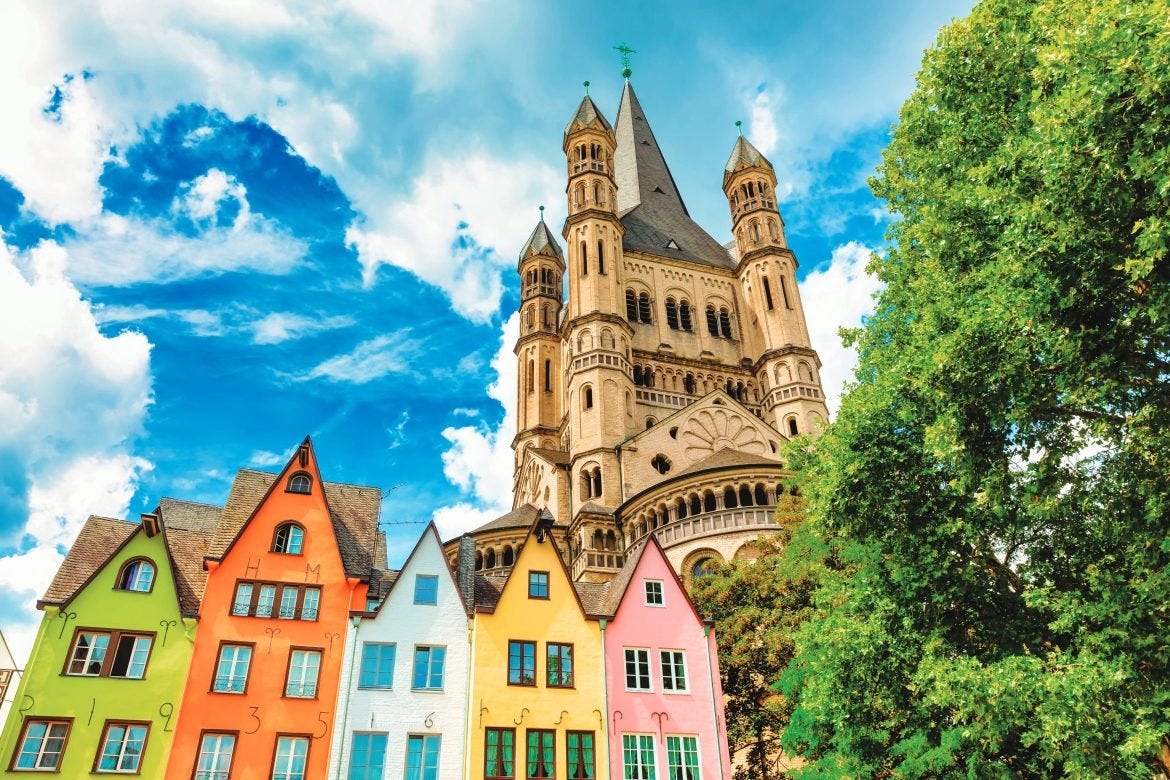
Among the most striking ancient edifices are 12 Romanesque churches. Originally built between 1000 and 1250, prior to the Gothic period of the Cologne Cathedral.
Walking a full circuit from St. Severin to St. Kunibert is a lovely way to explore the nooks and crannies of the city center, and it makes for a rewarding half-day’s activity. If you choose to visit just one of this Deity Dozen, by all means pick the eldest, St. Gereon (colognetourism.com/arts-culture/sights/detail/st-gereon), with its ten-sided sanctuary and gigantic sculpted noggin of the city’s patron saint laying face up in the churchyard. A warrior, Gereon was beheaded for his faith and is now invoked to combat migraines.
Contemporary gems include the science fiction-worthy harbor front Kranhauser (Crane Houses; also referred to as “cloud hangers”), a trio of inverted L-shaped office/apartment towers that seem to defy gravity, their horizontal upper levels perpendicular to their lower floors. Resembling Tetris game blocks rendered in glass and steel, they were built between 2006 and 2010, drawing inspiration from utopian city plans created by Russian futurist El Lissitzky in the 1920s.
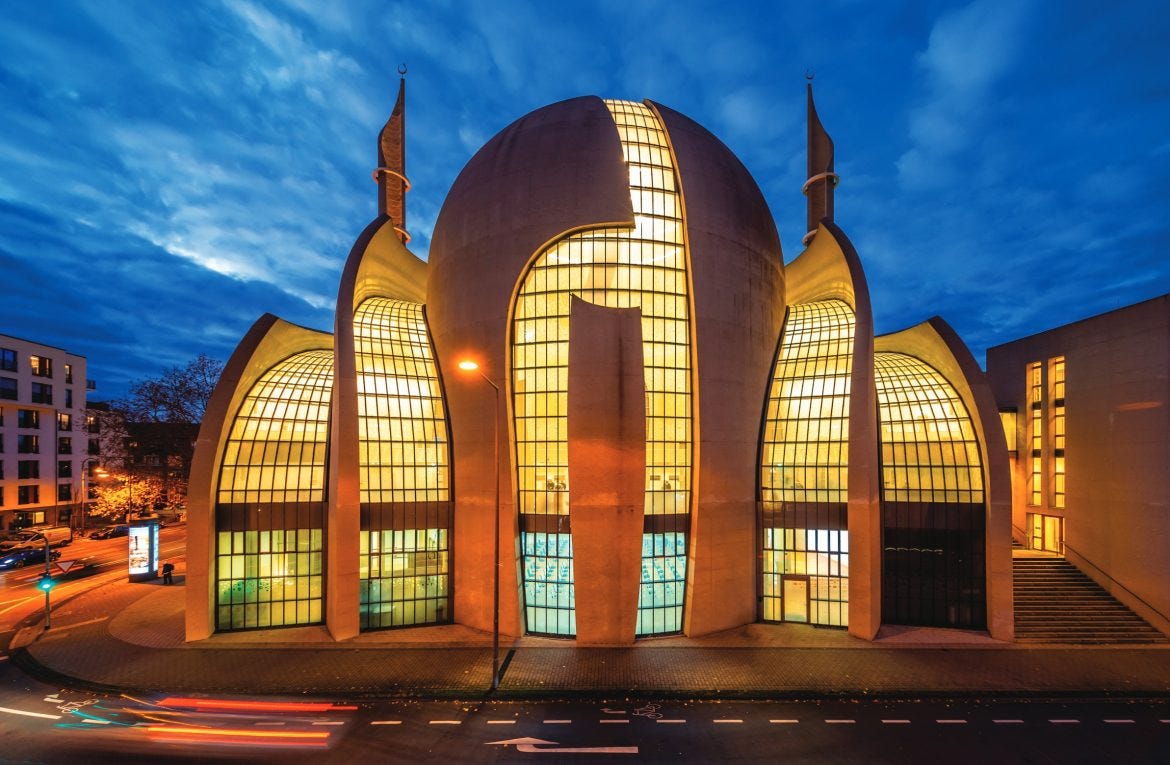
Another modern surprise is the Cologne Central Mosque (colognetourism.com), which echoes traditional dome-shaped houses of worship, but is constructed of abstractly shaped surfaces of white concrete that give it a flattened appearance, akin to an Alexander Calder sculpture. Yet its interior is surprisingly vast, with room for 1,200 worshippers in its voluminous ballooning central prayer hall.
Renzo Piano’s Weldstadthaus (global city building), which opened in 2005, is a mammoth glass tube of a structure built for Peek & Cloppen burg, the German department store chain, which has commissioned world renowned architects for several of its flagship locations. Locals have nicknamed the building “the whale,” but to me it resembles a Godzilla-scale slug, crawling its way through an otherwise workaday neighborhood. Not pretty, but pretty impressive nonetheless.
QUEER COMMEMORATION
While I’m an avid traveler and even lived in neighboring France for a time, it wasn’t until five years ago that I first visited Germany. As a Jewish gay man who grew up with a mother who bristled at the accents when I watched Hogan’s Heroes reruns after school, I felt an innate resistance to vacationing in Deutschland.
But after several visits, I’ve come to appreciate contemporary Germany for its largely open-minded culture, including commonplace recognition of the sins of WWII. There are memorials and exhibitions throughout the country, and lessons about the NAZI regime are a mandatory part of school curricula.
Cologne is one of three German cities (along with Berlin and Frankfurt) that, in addition to a memorial to all victims of the Holocaust, has an official monument to gays and lesbians persecuted under Hitler’s regime.
Unveiled in June 1995, in conjunction with that year’s Cologne Pride celebrations and the 50th Anniversary of Germany’s liberation from NAZI rule, the somber, sharp-edged modernist sculpture is crafted in gray and pink granite; the latter forming a triangle that evokes the identification patches worn by gay men in concentration camps.
Located in the riverfront Rheinpark, a short walk from the Cathedral and Ludwig Museum, the memorial’s setting alongside the Hohenzollern Bridge demonstrates remarkable civic candor: the area by the bridge was, for decades, a popular gay men’s cruising area. Today, Rhine river cruises dock by the bridge when they stop in Cologne.
INDULGING THE SENSES
Beyond sightseeing, a visit to Cologne would be incomplete without sightsmelling. The city is perhaps best known worldwide as the birthplace of Eau de Cologne. Over time, the French term has come to describe any light, fresh perfume, but in 1709 it applied exclusively to the innovative fragrance developed by Johann Maria Farina, the Italian-born, Cologne based perfumer.
Among Farina’s breakthroughs was the development of a distillation technique that allowed odorless alcohol, rather than animal fat, to be used as the base of a perfume. His celebrated scent was also the first to incorporate oil from citrus peels, in this case bergamot oranges, as well as flowers. His original formula became the preferred fragrance of royal families and other wealthy elites throughout Europe. In the early 19th Century, Napoleon ordered the pricey elixir by the liter.
Today, a ninth generation of the Farina’s descendants continues to operate the company, which is headquartered in the Cologne building it has occupied since 1723 and now also serves as a museum. Fascinating daily guided tours introduce visitors to the history, science, and artistry of the global perfume trade (farina.org).
“Cocoa-logne” is the heady scent you’ll discover emanating throughout the Cologne Schockoladen Museum (schokoladenmuseum.de), where your knowledge of chocolate will be elevated and your sweet tooth satiated. Exhibits follow the path of cocoa beans from cultivation to candy bars, frankly addressing sustainability issues involved in commercial agriculture and shipping. A greenhouse area offers the opportunity to examine cacao plants and pods, and a factory displays the marvels of automation: liquid chocolate is poured into bunny molds, and battalions of bonbons glide shop and café along conveyor belts in preparation for boxing.
Historical displays showcase the history of chocolate marketing and advertising and chronicle the evolution of chocolate from a luxury item to an everyday treat. And yes, liebchen, there’s a Wonka-worthy gift shop and café.
Sitting rather forlornly just across the road from this chocolate celebration is the small, pungent Senfmuseum (senfmuehle.net). More of an artisanal shop and manufactory after downsizing in recent years, it’s still worth a peek for travelers who prefer savory to sweet, are just culinary curious, or want to bring home a particularly weird souvenir. There’s also an antique mustard mill on display and an opportunity to observe the cold-grinding process that turns seeds and spices into heady spreadables, most of which are available for free sampling. With a bit of coaxing, the slightly grumpy staff (their temperament suits their condiment) will share their expertise on pairing foods with particular mustards before selling you a crock.
COLOGNE CUISINE
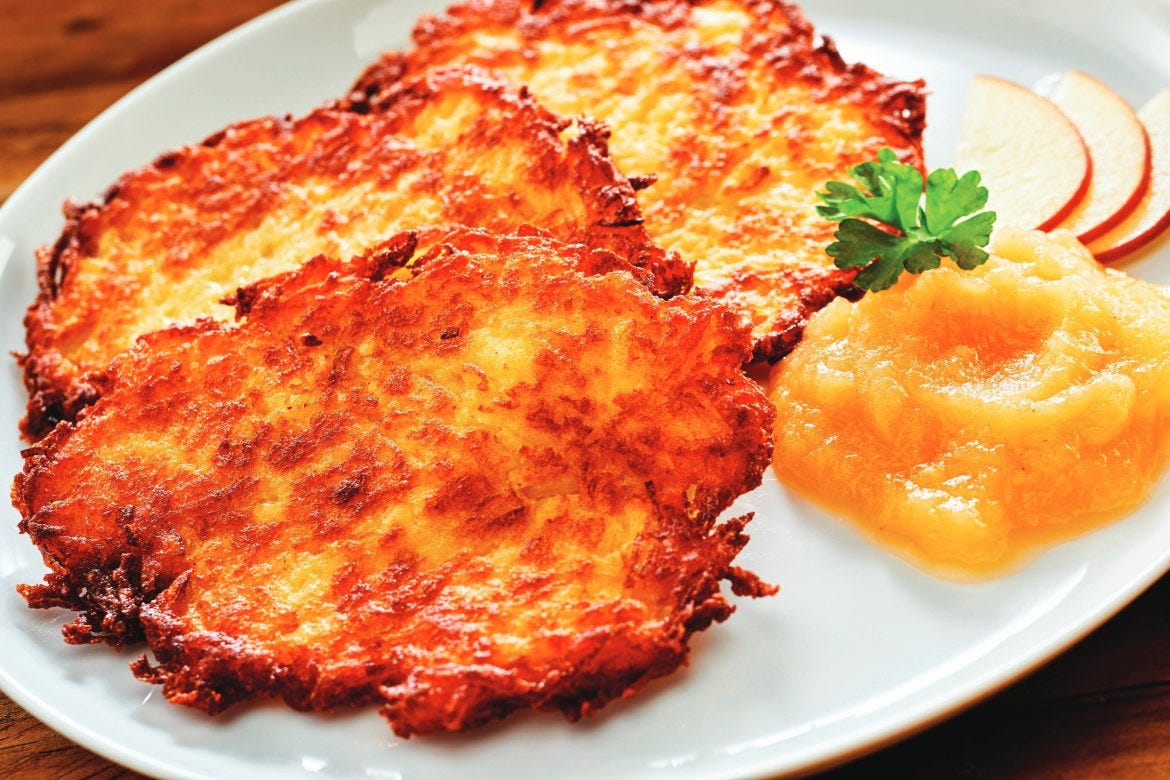
Whether or not your mouth waters for mustard, you won’t go hungry in Cologne. While some traditional local dishes may be a bit daunting to picky American eaters (blood sausage buns, anyone?), others will prove hard to resist. Reibekuchen are fried potato pancakes about the diameter of a hockey puck, crisp on the outside with a steaming, almost creamy interior. Often served with applesauce or umami-rich Maggi seasoning sauce, they can be enjoyed as a side dish in a restaurant or a snack on the run. Try one from the old town vendor Rievkoochebud (instagram.com/rievkoochebud).
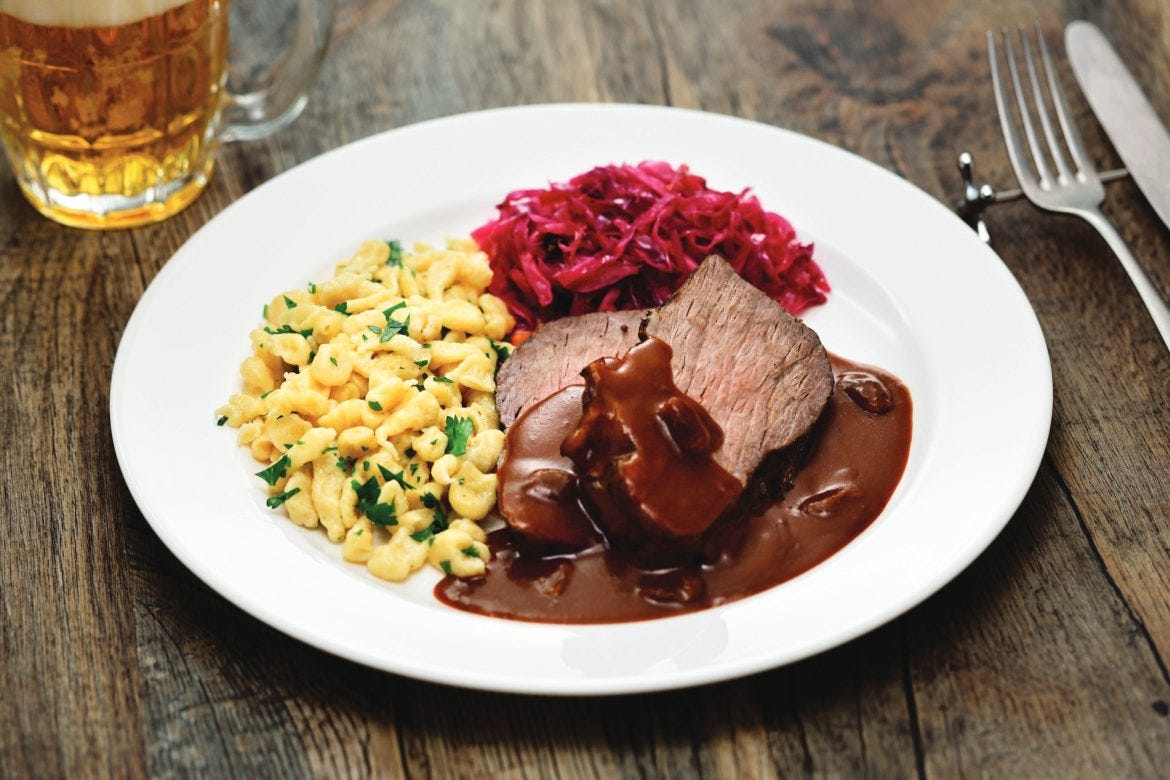
Pub grub makes for a classic Cologne supper, best enjoyed at one of the city’s dozens of brewery restaurants. A classic repast of bratwurst or ten der, vinegary sauerbraten (long-marinated beef, sometimes served with a gingerbread-enriched gravy) accompanied by cheesy spaetzle can be found all over town, but it’s hard to beat the gregarious crowd of locals and tourists that gathers at Fruh Brauhaus (frueh-gastronomie.com).
With or without a meal, Cologne’s beverage of choice is Kölsch, a pale, refreshing variety of beer crafted at over two dozen local breweries. Unlike heavier beers from other regions of Germany, sometimes served in hulking steins, Kölsch is served in small, clear cylindrical glasses, appropriate given its lightness and easy drinkability. Colognians probably wouldn’t approve of the comparison, but I find it to resemble a less carbonated Rolling Rock.
A Kölsch or six makes an ideal accompaniment to one of Cologne’s quirkiest signature eats: an open-faced sandwich of raw onion slices, sharp mustard, and a fat slab of Gouda cheese on a generously buttered rye roll. Not all that quirky, you think? What if I told you the name of this delicacy was Half Chicken (Halver Hahn)? The origins of the name are much debated, with one theory being that it was a poor man’s substitute at a time when chicken was too expensive to eat regularly.
Even Cologne’s most celebrated chef acknowledges the ubiquity of this local legend. At his eponymous and adventurous Michelin-starred restaurant, Maximilian Lorenz’s prix fixe menus change from month to month, always focusing on the creative nose-to-tail use of a single primary protein across multiple courses.
My visit featured lamb with separate small dishes made from the filet, the belly meat, and the tongue. But whether he’s dissecting ducks, rabbits, swine, or cattle, Lorenz can always include his elegant petit four-sized Halver Hahn course. After all, this half chicken is no chicken at all (maximilianlorenz.de).
STYLISH STAYS
There were Halver Hahn available on both the complimentary breakfast and the 24-hour bar menu during my stay at the hopping Hotel Ruby Ella (ruby-hotels.com). Snazzily decorated, and centrally located, this boutique property is housed in a former television studio building where popular German variety program The Harald Schmidt Show welcomed the country’s biggest film, music, and comedy stars.
In tribute to its past life, the public areas of the Ruby Ella display artful arrangements of vintage cameras, microphones, and musical instruments amidst designer Matthew Balons collection of brightly colored and artfully mismatched furniture.
Another choice option is the Koncept Hotel International (koncepthotels.com) with spacious, minimalist rooms, a large light-filled common area ideal for remote work by day, and pre-gaming before a night out. It’s located close to the old town and the heart of queer nightlife and offers a high degree of privacy thanks to fully automated check-in and key services.
For a more traditional grand European hotel feel, consider the Excelsior Hotel Ernst (excelsiorhotelernst.com). Posh and elegant, but thoroughly modernized, it has on-site spa facilities, a dedicated parlor for afternoon tea, and the duly acclaimed restaurant Taku that specializes in gorgeously composed Asian-influenced dishes with an emphasis on seafood, both raw and cooked
A BREATH OF FRESH AIR
Beyond the obvious choice of a stroll along the banks of the Rhine, Cologne offers a number of other particularly pleasant ways to spend a few hours in fair weather. Just a few minutes from the heart of the city via the easily navigated subway system is The Flora and Botanical Garden (cologne-tourism.com), with over 12,000 plant species in elegant gardens landscaped in traditional English, Italian, and French styles. Step into the stunning Glass Palace and its adjacent greenhouses to discover curated collections, including a selection of over 400 camellia species, as well as plants over 100 years old.
Alternatively, a subway journey of about 30-minutes will take you to Decksteiner Weiher (cologne-tourism.com), a bucolic, forested park with a central lake and a canal lined with handsome chestnut trees. While weekends can get a bit crowded with picnicking and exercising locals, weekdays here offer a sublime sense of escape. It’s the perfect spot for a romantic meander.
Nestled in the midst of the busy city is the Stadtgarten, Cologne’s charming first public park, a green space for socializing centered around a beer garden, terrace restaurant and outdoor stages that regularly host jazz performances in the warmer months.
FRIENDLY NEIGHBORHOODS
The Stadtgarten makes an ideal start or finish to an afternoon exploring the narrow streets of the Belgian Quarter, Cologne’s center of hipster chic. Thick with purple wisteria in springtime, the Quarter is a scavenger hunt of gifty boutiques, designer-owned clothing shops, and what seems like an endless assortment of cafés.
Indoor-outdoor Kaffeesaurus (kaffeesaurus.com) is a prime people watching hub, its light breakfast and lunch fare are delicious, and its own ers’ dedication to offering only sustainable and fair trade coffee beans makes even the richest latte feel a bit virtuous.
Catherrine Leclery, the celebrated trans Brazilian-born drag per former based in Cologne is the proprietress of Catherrine’s im Apropos (apropos-store.com), a café within the Quarter’s super slick branch of Apropos, the fashion and home goods concept store with six branches throughout Germany. For ten bucks or so, you can have a coffee, a pas try, and, occasionally, a glimpse of Leclery; a much better deal than the shop’s outrageously spendy menswear, like $800 Moncler puffer vests and $1000 Zegna suede sneakers
The similarly eclectic and appealing Ehrenfeld neighborhood is a hive of art galleries, vintage shops, mural-splashed alleys, and repurposed spaces like Club Banhof (clubbahnhofehrenfeld.de), a beer garden and genre-agnostic music venue, featuring everything from punk to techno, tucked beneath an old railroad arch.
A NIGHT TO REMEMBER
Ehrenfeld is also where I spent an illuminating evening at the Neptunbad (neptunbad.de). This esteemed playground of pools, saunas, and steam rooms, along with a clubby wood-panelled bar and restaurant where you can lounge in a rented bathrobe, has been in operation since 1912.
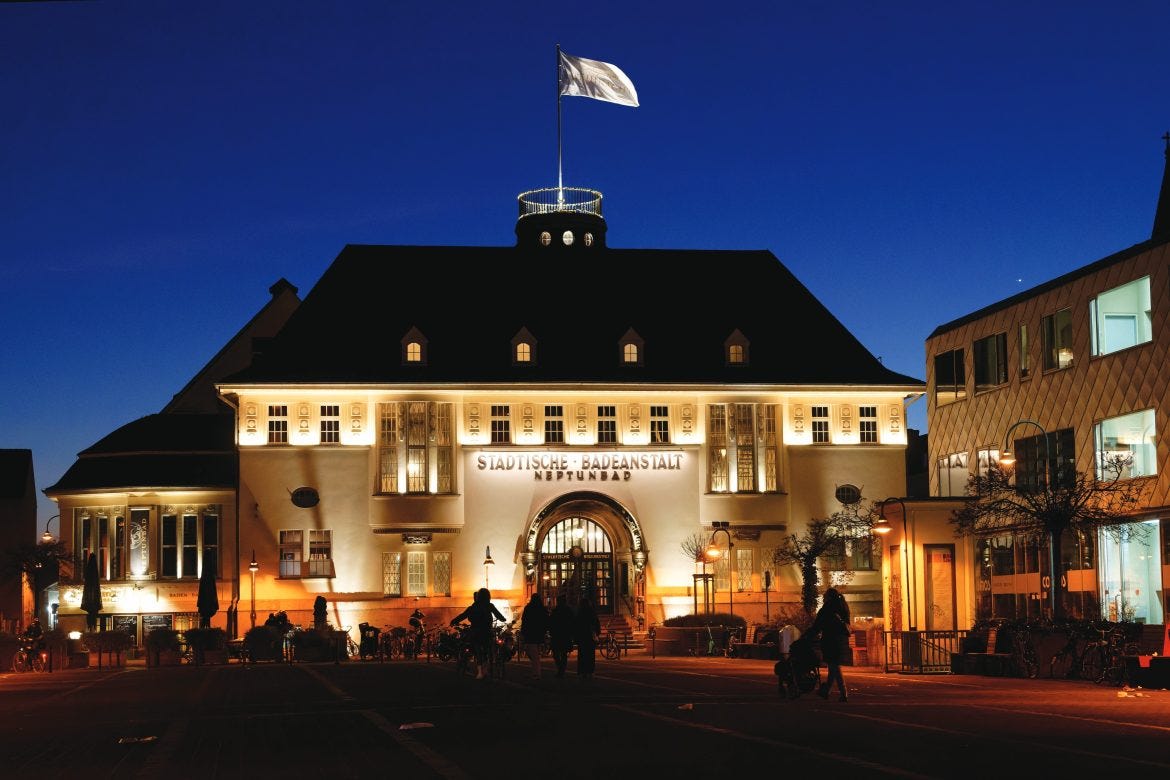
To be clear: Neptunbad is not a gay bathhouse. It’s open to all paying customers in the venerable European tradition of bathing for relaxation, rejuvenation, and polite conversation, a practice I’ve come to look forward to on my travels, having had wonderful experiences taking the waters in Iceland, Finland, Hungary, and at hot springs in the western U.S.
But it turns out that many German thermen, as they call these spa-like facilities, come with a bit of a twist. Reflective of the FKK (Freikörperkultur, or Free People Culture) movement and philosophy that first took the country by storm in the late 1800s and advocates for the physical and mental health benefits of nudity, Neptunbad and similar baths nationwide strictly forbid the wearing of swimsuits. They’re also fully coed. Not just in the pools, hot tubs, and saunas, but also, to my surprise, in the locker room!
Over 40 years had passed since I’d last been in close physical proximity to what my childhood pals and I referred to, with no small degree of awe, as naked ladies.
With plenty of irony, but without a doubt, this was the most unforgettable adventure during my visit to the fabulous city of Cologne.