
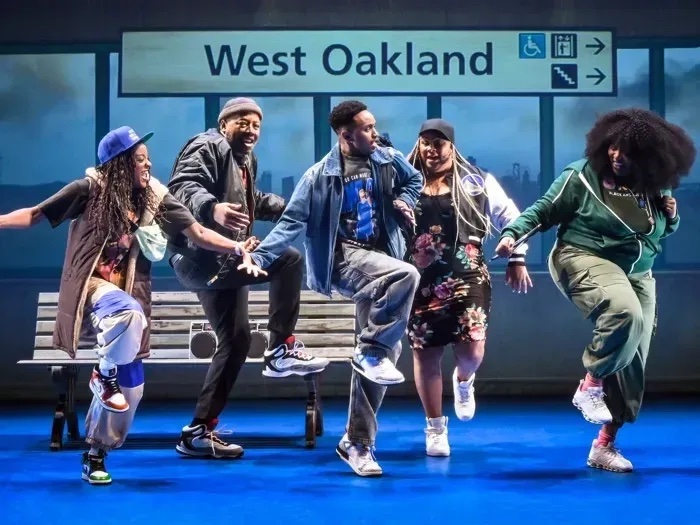
“Co-Founders,” a locally created hip-hop-meets-high-tech musical now in its premiere production at ACT’s Strand Theater, is jubilantly humane.
The characters and performances are big and bright; the toe-tapping beats infectious; the affectionate take on Oakland a delight. And the script and lyrics–by Ryan Nicole Austin, Beau Lewis and Adesha Adefela–lovingly honor both individual and collective tenacity.
The show’s protagonist is Esata (Aneesa Folds), a young Black coder intent on Silicon Valley success. But the writers surround her with a supportive family and community that prove essential to her ultimate achievements.
There’s a cheerful cartoon simplicity to the storytelling in “Cofounders.” It has the zip and hook of a “Schoolhouse Rock” civics lesson. In advocating for the importance of minority voices in tech, the show’s broad stroke approach makes it more of a cheerleader than a change agent, but the sis-boom-bah sure feels good.
Exhilarating performances
Folds (who departs the show on June 22) is a major talent, grand in stature and voice. From the inner ache of ballads like “Anchored to the Shore” to the in-your-face beats of “All People Powered,” her expressively modulated alto brings a depth of emotion to lyrics that sometimes lean toward the prosaic
Adefela brings her own script to life, poignantly playing Esata’s widowed mother, Deb, who struggles to keep up with house payments in a gentrifying neighborhood. Displaying the versatility and humor of a skilled improviser, she also creates a pair of sharply drawn tech investors, a New Yorky yakker and an imperious Indian businesswoman.
Co-writer Austin also proves a welcome stage presence as Esata’s frank talking neighborhood friend Kamaiyah; a paragon of side eye, sass, and, ultimately, solidarity.
As a tech lord’s impish major domo, Deanalis Arocho Resto goes full-on Liza in the stand-out song-and-dance number, “Pivot”; and Jordan Covington plays Esata’s pal Dhameer with giddy verve and flashy footwork (The buoyant choreography is by Juel D. Lane).
Roe Hartrampf brings layers of subtlety to Conway, Esata’s initial collaborator at a high-profile start-up incubator. Potentially portrayed as a white-privilege punching bag, Hartrampf makes Conway morally complex and gives believable texture to his redemptive story arc.
(Disappointingly, Esata’s detour into big money tech temptation and her U-turn back to virtue are rendered in hasty shorthand, told by the script more than felt by the audience).
Screen savor
While Esata is the show’s hero, ingenious stagecraft makes a sandwich of the entire cast, which performs between two planes of projections:
On an upstage screen, filmed cityscapes roll past; Viewmaster images click by; and minutely detailed environments–a garage workshop, a boardroom with skyline views–appear and disappear, no blackouts or pauses required.
Downstage, a gauze spans the entire proscenium arch, so sheer that it’s invisible when not being used to show us the content of character’s digital device screens; foreground scenic embellishments, like a Tesla cybertruck cameo; or fun-fonted supertitles to speedy rap songs, which help the audience stay immersed and engaged.
The projection design, video content, lighting and scenography are by Frederic O. Boulay, David Richardson, Xavier Pierce, and Arnel Sanciano. That their brilliant work doesn’t steal the show is a credit to their collaboration with director Jamil Jude.
As slick and occasionally surprising as it is, the tech clearly in service to the live performances. The show, as the lyrics say, is always “people powered.”