
As I took my place in the passport control queue after landing at Bangkok’s Suvarnabhumi Airport last September, I noticed a sticker on the inspection officers’ booth.
It was heart shaped, rainbow striped, and emblazoned “LGBTQIA2S+” in achubby, cheerful font.Even if this were simply an official welcome to traveling queers, it would have been a remarkable public gesture on the part of a federal government. But these stickers, posted prominently at each of Thailand’s five major international airports, are public reminders of the Thai government’s “Welcome Pride by Immigration” campaign.
Launched in August 2024 the program offers assurances that visitors with discrepancies between their gender presentation and the photograph or sex indicated in their passports will be treated with respect and be assisted in confirming their identies.
“The purpose,” according to a government news release, “is not only to smooth the way for LGTBQ+ travelers, but also to show the world that Thailand places importance on gender equality.”
A week after my arrival came another sign of the country’s social progress:
Thailand’s king signed a national marriage equality bill into law, the first in any South Asian country and only the third in Asia as a whole, following the lead of Taiwan and Nepal.
Isn’t it Thai-ronic?
I was back home in California when the Thai same-sex marriage law went intoeffect on January 23. More than 800 same-sex weddings were scheduled to take place nationwide that day. A joyful mass ceremony for over 200 couples was held in Bangkok.
Just three days earlier, in Washington, DC, our 45th president had been burped back up as our 47th, then promptly signed an Executive Order condemning “Gender Ideology Extremism” (Further anti-LGBTQ policies would be announced in the following days).
In the winter gloom that followed, I summoned moments of respite byrevisiting Thailand in my mind. focusing on sunshine over fog; forward motion over backsliding; the scent of mangos over the nonsense of Musk; the Four Seasons of White Lotus over four more years of Orange POTUS.
Now more than ever, for queer American travelers, a, vacation in Thailand offers a precious sense of escape.
Having visited the country four times over the past fifteen years, I would highly recommend my most recent itinerary to first time visitors. It’s an experiential sampler of three distinctive Thai environments that can be unhurriedly enjoyed in less than two weeks: Bustling Bangkok; chilled out Chiang Mai; and a ritzy resort in Krabi.
Bedazzled by Bangkok
A great escape demands a great getaway car. In Bangkok, to me, that means ahot pink local taxi; a Toyota painted in a hue so intense that it’s racing toward magenta even at a standstill. Grab one at the airport and ask the driver to step on it.
Along winding highways, glassy cantilevered towers jostle against modest family homes. Neon spills from billboards, then ripples over corrugated tin roofs.
In densely packed urban neighborhoods, sidewalks teem with tarpaulin-shaded ad hoc kitchens where street hawkers deep fry oysters, toss noodles in smoking woks, chop papayas and pineapples into bite sized chunks, and brush sweet glazes on skewered morsels of charcoal grilled chicken and pork.
Some blocks are dominated by multi-storied mega-malls, either packed with global luxury brand boutiques or chockablock with workaday kitchenware, bolts of fabric, and rack after rack of inexpensive clothing.
There’s a jolt, a hustle, a high-low aliveness to this sprawling city of 9 million thatwakes you up and sets your senses abuzz.
Given its restless cosmopolitan energy, restful accomodations are essential tomaking the most of a visit to Bangkok. And that’s not a problem. Countering the grit and electricity of its vibrant street life, Thailand’s capital offers blissful hotel oases, with dozens of ultra-luxurious options—featuring spas, pools, gourmet restaurants and spectacular design— available for just a fraction of what one would pay for similar digs in London, Los Angeles, Manhattan, or Paris. Well-situated five star properties routinely offer rooms for under $200 a night.
My most recent trip introduced me to a new favorite accommodation, the Salil Riverside, which opened in 2022 on the east bank of the Chao Praya River, a main artery through Bangkok.
The hotel’s unique rooftop Rabbit Moon Aquatherapy circuit provides an ideal way to refresh and revive after a long travel day. Guests move at their leisure through a warm pool-like water course; at each of nine stations, hydromassage jets focus on a particular area of the body. It’s a perfect reset.
The Salil’s public areas and guest rooms are decorated with fanciful artworkdepicting creatures that fuse the realms of land, sea, and sky. In the lobby, there’s sculpture of a Pegasus with the tail of a seahorse. More crossbred critters appear on guest room wallpapers: Kitty cat-cum-crocodiles, butterfly-winged unicorns, and miniscule monkeys fused with orchid blooms.
Charming statues of yoga-posed rabbits greet visitors to the Salil’s resort-like courtyard, where a long infinity pool stretches toward a lush green lawn. Its flanked by an array of eateries including a European-style wine bar, modern Thai fine dining, a Michelin-starred sushi spot, and an outpost of celebrated Japanese ice cream parlor Rintaro (Try a poolside scoop of intense black sesame).
Where the lawn meets the river, the Salil’s complementary shuttle dock offers regular boat service to the high-end ICONSIAM shopping mall and a BTS Skytrain monorail station with access to all of Bangkok.
A ride on the river
Among the classic outings for first-time visitors to Bangkok is a ride on the Chao Praya in a brightly painted longtail boat. A traditional mode of transport in the city, the narrow wooden vessels became an indelible part of global pop culture when James Bond commandeered on one to zip down the river in The Man with the Golden Gun.
The biggest downsides of these excursions are the diesel exhaust and deafening roar of the boats’ powerful outboard motors. While the cacophony might ratchet up the fun of a movie chase scene, it makes it virtually impossible to hear anything your guide or captain might have to share. It’s all excitation, no education.
Instead of the fast and the furious, opt for the slower and studious: Since the end of the pandemic, several tour companies have launched small fleets of solar powered longboats, which glide silently along the river on contemplative two-hour itineraries on off-the-beaten-path canals, traversing small villages where vendors display fresh fruit and fish by the banks. Buddhist temples rise along the riverbanks, their enormous golden idols, domes, and multi-colored stupas agleam.
My solar boat captain and guide, felicitously named Sun, pointed out the ornately decorated miniature buildings that sit atop pedestals outside many canal-side residences. These “spirit houses” are shrines, honoring the land on which each home is built and said to bring good fortune. After having them called to my attention, I found myself on a reflexive scavenger hunt, spotting them at hotels and businesses as well as residential properties all over Thailand.
Even amidst Bangkok’s urban clamor, nature maintains a persistent presence along this winding waterway. Giant silver catfish swim below the surface; plovers and egrets stride through the shallows; night herons swoop overhead; and, most remarkably, gray-green monitor lizards, as long as six feet and weighing up to 50 pounds, loll in the sun along the shore, occasionally slithering into the river for a cooling swim.
Wats next
After taking in the impressive temple views from the river, you’ll no doubt want to explore some of these Buddhist prayer sites, known as “wats,” up close. But with over 400 throughout the city (and thousands more temples to tempt you as you travel elsewhere in Thailand), it can be hard to choose which to visit.
While wandering the capitols endlessly fascinating shopping streets and wet markets, feel free to duck into any of the dozens of neighborhood temples you’ll encounter. Amidst the clamor and congestion of Bangkok’s dense urban environment, these intimate sanctuaries—often no larger than a small house—provide welcome respite.
Quieter and cooler than the sunbaked streets outside, they offer the opportunity to sit silently and meditate (or just catch your breath) for a few minutes of calm, surrounded by gilded statuary, piled offerings of colorful fresh fruit, and the sweet smoke of sandalwood and herbal incense.
But Bangkok’s most celebrated temple complexes incorporate many buildings, spreading over areas as large as several city blocks. A visit can easily take up to two hours. If you’re in the city for three days or less, I’d suggest sticking with one or two of the following:
Wat Phra Kaew, is known as the Temple of the Emerald Buddha, in honor of its most impressive artifact, a 26” Buddha figure which is actually carved from green jasper stone, not emerald. It has a wardrobe of three golden outfits which are changed seasonally.
Located within the sprawling grounds of the royal Grand Palace, the temple’s many elaborately decorated buildings display a wide range of architectural styles that reflect the complex’s history, which dates to the 18th century. It attracts a huge number of visitors–over 20,000 a day—so coming here first thing in the morning is highly recommended.
Wat Pho, the Temple of the Reclining Buddha, is located just a short walk from Wat Phra Kaew, making it possible to combine the two in a busy single day. The highlight here is a gold-leafed statue of the Buddha lying on his side; 150 feet head-to-toe and 50 feet shoulder-to-shoulder, the figure dominates the interior of a narrow chamber that was actually built around it. As you admire this incredible effigy, note the undersides of its enormous toes, whorled with mother of pearl inlays.
Wat Pho is also home to a school of traditional medicine where visitors can experience an authentic hour long Thai massage for the jawdropping price of only about $12 U.S. Guests slip into a set of loose-fitting garments and receive their treatments fully clothed in an open pavilion alongside dozens of other tourists getting tenderized.
Compared to most spa massages, the traditional Thai method is fairly intense, involving the bending and manipulation of your limbs and aggressive use of the masseur’s forearms, elbows, and feet on pressure points. So gruntingly good.
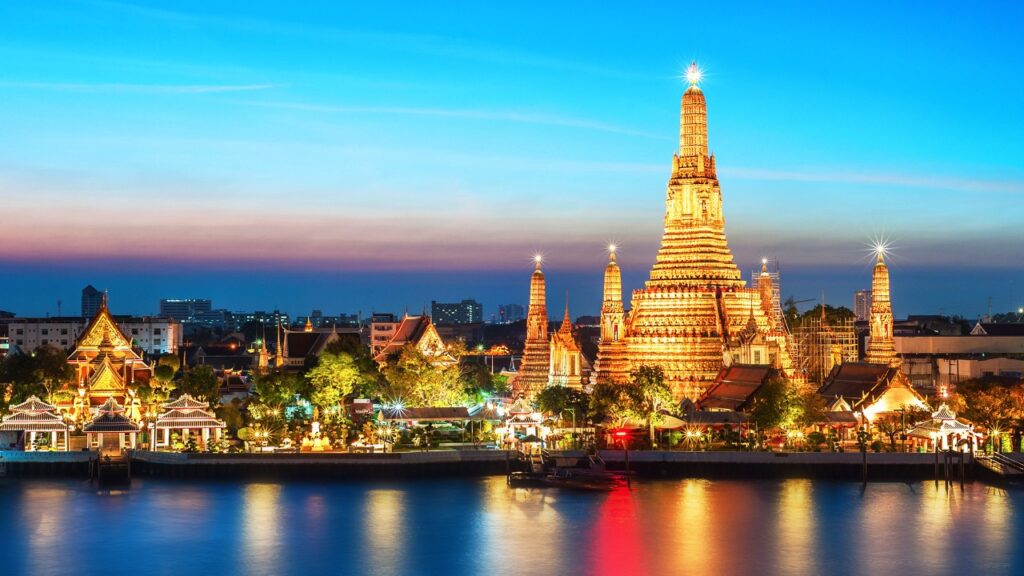
My final favorite Bangkok temple is Wat Ranatchatdaram, constructed the 1840s. The main building’s 37 metal spires are clustered in a grand pyramidal formation, inspired by Sri Lankan architecture and representing Buddhism’s 37 virtues of enlightenment.
By day, guests can climb to the top of the central tower, seven stories high, to see an alleged relic of the Buddha (said to be a post-cremation bone fragment) and, more rewardingly, a panoramic view of Bangkok over the angled red rooftops of the surrounding temple buildings. At night, outdoor lighting sets the complex aglow; a mystic, romantic vision in the heart of the city.
Feast on the street
Bangkok is the street food capital of the world; a city-sized curbside buffet. Don’t be shy. If you’re nervous about sanitary matters, stick to vendors with long lines. Fierce competition—literally thousands of hawker stands and tiny storefront kitchens, many selling similar dishes—keeps prices down, quality and safety high. (Many food stalls are closed on Mondays, when the city conducts a thorough street cleaning).
It’s not unusual for local residents, many who live in cramped apartments, to have two or more meals a day on the street. Lots of vendors keep stacks of low plastic stools and a few rickety tables on hand, so customers can sit on the sidewalk, eating amidst the fragrant, smoky hubbub; its a social scene and a people-watcher’s paradise.
The Yaowarat district, Bangkok’s Chinatown, has the city’s densest street food scene. The neighborhood around the Victory Monument and the significantly less hectic (but no less delicious) Bang Khun Non area are also excellent choices. All are easily accessible by Metro.
While many hawkers speak sufficient transactional English, feel free to place orders by pointing at whatever looks good on the grill, the griddle, or in somebody else’s bowl. Frankly, this is less stressful than struggling to translate a non-English menu (Lots of Bangkok restaurants offer photo-illustrated menus for the same reason).
It’s easy enough to find dishes akin to those offered at your hometown Thai restaurant, but here are a few less commonly found in the U.S. that are well worth seeking out:
Khao soi is a red coconut milk curry with morsels of chicken or pork, pickled mustard greens, ground chilis, shallots, lime, and, most distinctively, flat egg noodle strands cooked two different ways; boiled soft in the broth and fried crispy as a topping.
Hoi tod, is an egg and rice flour batter loaded with fresh-from-the-shell oysters and fried in a giant wok. You can have it cooked to a crackle-skinned crepe-like texture, or served softer, like an omelette. Scattered with crunchy bean sprouts and accompanied by a sweet dipping sauce, it’s one of the best non-spicy local specialties. (At about $3, it costs about the same as a single oyster on the half-shell in many American restaurants).
My favorite Thai snack is kanom krok, salty-sweet domed mini pancakes made in a dish-specific cast iron pan dimpled with shallow indentations, each about the circumference of a ping-pong ball. Two coconut milk batters are poured into each divot several minutes apart: the first, in direct contact with the hot metal, forms a crisp toasted bowl, while the second is allowed to cook to a slightly firmed custardy texture. Topped with snips of green onion, a few bright yellow corn kernels, or shavings of dry coconut, they’re eaten while still warm; a treat in texture as well as taste.
On my recent trip, I made a special pilgrimage to one storied Bangkok restaurant with table service: The original Thipsamai. It’s one of the the oldest spots specializing in the dish that symbolizes Thai cuisine to most Americans: pad Thai.
Stir-fried noodle dishes were introduced to Thailand by Chinese immigrants centuries ago. But beginning during WWII, when there were major rice shortages, Thais began eating noodles more frequently, developing Thai-ified dishes that appealed to their own traditional palate, incorporating sour, salty, and sweet elements.
Thipsamai’s signature recipe incorporates palm sugar, tamarind paste, and fish sauce , which are combined with fresh noodles. The noodles are then stir fried over charcoal in an oil made from shrimp heads, which imparts a distinctive buttery umami to this version of pad Thai.
Observe the final step through the plate glass window to the busy kitchen: The mound of slippery noodles is fully enveloped in a tissue-thin veil of fried egg white, a gift to unwrapped by the diner.
Gay nightlife
Widely considered the queer capital of Asia, Bangkok is chockablock with gay bars and clubs, which are most densely concentrated in the city’s central gayborhood, the Silom district. Given Bangkok’s tropical weather, a sultry stroll along the area’s main streets, Silom Soi 2 and Silom Soi 4, is the best way to get the lay of the land.
You’ll feel like a kid in an eye candy shop as you weave through the gaggles of gays spilling onto the sidewalks in front of brightly lit storefront cocktail bars and doing some ogling of their own from the prime terrace seating outside The Balcony Pub and The Stranger Bar, also home to one of the city’s most popular drag shows.
The dance floor is on the fifth floor at one of the newest clubs, RUSH. Opened in 2024, it quickly earned a reputation as one of the city’s friskiest venues; the second floor is entirely dedicated to a dark room, and the club hosts frequent jockstrap and underwear nights. Immediately next door is G Bangkok formerly known as G.O.D., for Guys on Display), a perennially popular dance destination that seems to have only gotten busier since its new neighbor moved in.
When spending time in Silom, you’ll encounter a large number of kathoey working as servers and drag performers. Though referred to as “ladyboys” by many Westerners—and Thai nightlife promoters advertising to Westerners—the term is widely viewed as pejorative.
In traditional Thai culture, kathoey, who have male genitals but otherwise present as female, are considered to be members of a natural third gender; akin to mahu in some Pacific Island societies and Two-Spirit people in many Native American belief systems.
Today, though kathoey do face discrimination, they are more broadly accepted in Thailand than genderfluid or female-presenting males are in other Asian and Western countries.
While the tourist-centric drag shows in Silom have long leaned into campy, old school performance styles, Bangkok’s new premiere drag venue, The House of Heals, located outside of the gayborhood, offers an evolved, elevated approach, better aligned with the world’s growing respect for diverse gender expression.
Founded in 2020 by Pangina Heals, the television host of Drag Race Thailand, the luxuriously decorated club is perched on the 33rd Floor of the five star Marriot-operated Renaissance hotel.
Competing with vertiginous views of the neon lit city, the queens here are up to the challenge. Often singing live, rather than lip syncing, and accompanied by ace musicians, they bring an astonishing level of polish and professionalism to venue’s stage, which is kitted out with a lighting and sound system worthy of a Vegas showroom despite being about one fifth the size.
All are welcome, but the crowd leans queer and well-heeled, with a nice balance of travelers and stylish locals. House rules explicitly prohibit both homophobia and racism.
The “can’t miss” daytrip
After each of my past visits to Bangkok, my biggest regret was passing on a daytrip to ancient Ayutthaya, which had been enthusiastically suggested by friends and travel experts. The capital of Thailand from 1350-1767, Ayutthaya is just a 75 minute drive from Bangkok Having finally made the excursion, I heartily agree that it’s a must for visitors’ itineraries.
The original city was destroyed by an invading Burmese army; its spectacular 750-acre remains are now a national park and UNESCO World Heritage Site. Add Ayutthaya to Cambodia’s Angkor Wat, Peru’s Macchu Pichu, and Mexico’s Chichen Itza on your “Ruins Worth Doin’” list.
Stone and brick remnants of once-grand wats and palaces are strewn across expansive lawns, like the pieces of some mysterious giant jigsaw puzzle. Block-long rows of weathered prang (spires) as tall as 115 feet stand sentry near the edges this ghost town, the finest details of their elaborate, still visible carvings have been worn smooth by centuries of sun, rain, and wind.
Walk amongst them and you’ll encounter a disturbing array of beheaded Buddha statues; their noggins lopped off by looters and sold to private collectors. One stray head, though, has become a legendary landmark:
The sandstone head, with a sweetly smiling face, was abandoned beside a sapling Bodhi tree. As the tree grew, its gnarled above-ground root system slowly enveloped the head,
Today, Buddha’s face pokes out from a tangle of roots, calmly beaming at the hundreds of daily visitors who come to see this unlikely fusion of art and nature.
After exploring some of Ayutthaya’s oldest landmarks, I headed a few miles east to one of its newest and most eyepopping: the Purple Temple, aka Wat Klang Khlong Wattanaram. Funded by community donations to a visionary local abbott, it’s easy to imagine the chapel being nominated as “Wat most likely to host a rave.”
Its interior, decorated in a cornea-searing spectrum of violet, magenta, periwinkle and grape with neon green and orange accents, makes you feel like you’re inside of a black light poster or a Buddha-themed pinball machine.
And the floor will only floor you more: Realistic sculpted koi fish are embedded within a thick layer of transparent blue resin, allowing worshippers to walk on water.
This fascinating day continued with a late lunch, royal banquet style, at
Suriyan Chandra.This former steam-powered rice mill has been transformed into an open-walled pavilion with charming mix of crystal chandeliers and rattan furniture, white tablecloths and wooden floorboards. Its luxurustic.
One fundamental difference between Thailand’s inexpensive street food and meals at pricier Thai restaurants like Suriyan Chandra is in the presentation.The same seductive mix of sweet, spicy, and savory flavors casually dished out at hawker stands is transformed into edible artistry: pastel blue dumplings are shaped like roses and colored with the petals of butterfly pea flowers; rice is served from woven baskets belted around servers’ waists; whole fried fish are curled into spiral towers.
Suriyan Chandra’s upholstered, sun-shaded antique parlor boat docks just outside the restaurant on the Noi River. A brief post-prandial cruise with tea service was a lovely finish to my time in Ayutthaya.
Thailand’s highlands
Domestic flights north to Chiang Mai from Bangkok cost under $50 and take just over an hour, but this highland mountain city feels a world away from the capital. Yes, its Thailand’s second largest metropolitan area, but it trails by a huge margin, having only about a tenth of Bangkok’s 10 million-plus population.
With generally low-slung architecture and no skyline to speak of, Chiang Mai—particularly in the areas most popular with tourists—feels more like a small town than a big city.
I spent three nights at the ideally situated Na Nirand Resort, in the heart of busy old town, but tucked away down a small street, quiet and secluded. The 42-room property features a village-like cluster of buildings around an elegant tree-lined swimming pool. A small, tiered amphitheater on the bank of the Ping River provides a perfect spot to take in the sunset.
Daily breakfast is served in the resort’s Glasshouse restaurant, perched atop a platform at second story level. A light-filled aerie with floor to ceiling windows and a peaked glass roof (with translucent sheers to filter the sun), the room lifts your mood invites you to linger.
As you might anticipate, the nightlife scene here is much less developed in Bangkok. That’s even more the case after many of Chiang Mai’s queer establishments closed during the pandemic and never reopened. You’ll still find a lively strip of watering holes close to the famous Night Bazaar. Adam’s Apple and the Ram Bar have surprisingly elaborate entertainment given their modest size. Be sure to tip the performers—While never stinting on energy and enthusiasm, they sometimes outnumber the customers on slower weeknights.
A taste of old town
Absent the hectic crowds and sometimes chaotic traffic of Bangkok, old town Chiang Mai is fun to explore by foot, peeking down small streets and unpaved alleys, shopping for local handicrafts, taking in views of the surrounding Thanon Thong Chai Mountain Range and, of course, grazing on street vendors’ specialty snacks.
Influenced by Burmese and Laotian culinary traditions, some of the best-known bites in Chiang Mai are markedly herbaceous, perfumed with locally cultivated spices and seasonings.
Morsels of grilled pork sausage called sai oua, are served on wooden skewers and accompanied by sticky rice. They’re traditionally cut on the bias, revealing interiors colorfully flecked with lemon grass, galangal, lime leaves, cilantro and red peppers.
Laab (often called “larb” at Thai restaurants in the U.S.) is a tongue-tingling meat salad. most commonly made with pork (laab moo), although versions using chicken (laab gai) or even tofu can be found (more often in restaurants than at street stalls). The protein is ground, sauteed with shallots, then tossed with a fragrant mélange of cilantro, sawtooth coriander, toasted rice powder, lime juice, chili flakes, and funky fish sauce. Torn mint leaves are folded in as a finishing touch.
While wandering in search of tempting morsels that catch your fancy is the best way to get a sense of the local cuisine, visitors pressed for time can also find everything under one roof in the food section of the Chiang Mai Night Bazaar, open from 5pm to midnight daily. There’s often live music here, too; often Thai musicians singing heavily accented versions of English-language pop chestnuts (I caught a particularly endearing performance “Take Me Home, Country Roads”).
To catch the everyday vibe of expat Chiang Mai, hang out at one of the ubiquitous friendly cafés: They’re the intersection of two of the city’s recent claims to fame: Digital nomads and artisanal coffee.
Over 30,000 American, Asian, and European expats have relocated here to take advantage of the high quality and low cost of living. A quite comfortable lifestyle can be achieved for under $2,000 a month.
Around the world, remote-working digerati frequent coffee houses. But in Chiang Mai, known as Thailand’s capital of coffee, the cafés proudly grind and brew locally grown beans. Over the past decade, Arabica coffee has become a significant addition to Chiang Mai and northern Thailand’s regional agriculture. Several local businesses, including the Chiang Mai Hill Tribe Coffee Tour offer half-day trips to visit small farms along with coffee processing and roasting facilities.
Among Chiang Mai’s pioneering coffee companies is Akha Ama, a social enterprise founded in 2010, which supports indigenous farmers in small mountain village. Their java is available by the cup and kilogram at several branded shops around town and as far afield as Tokyo.
At the multi-purpose queer-owned WOO Chiangmai, coffee, breakfast, and lunch are served with creative flair (Try the Passionfruit Americano). This chic converted warehouse also functions as a florist shop, art gallery, and home design boutique. Over a dozen chandeliers, classic and contemporary, hang from the ceilings.
Rural exploring
In the countryside just outside of Chiang Mai, the On Tai Creative Village offers the unique opportunity to try one’s hand at traditional crafts under the tutelage of local residents proud to share their heritage.
My English-speaking host, Chinda, worked as a government-licensed Thailand tour guide for years before helping to develop this community enterprise, which allows her to stay close to home.
Gathering a half dozen visitors on a wooden platform overlooking acres of farmland, she provided a fascinating lesson in traditional textile dyeing with natural pigments.
We dunked bandana-sized white cotton cloths into huge bowl-shaped metal cauldrons where water had been boiled with ingredients including mango leaves to make green dye; turmeric for orange; and indigo flowers for blue. Chopped segments of woody banana tree stems bobbed in each potion; their sap serves as a fixing agent to keep the dyes colorfast.
“Do know what we use to make the red,” Chinda inquired mischievously, “Insect poo!”
(In fact, this material, while indeed secreted by insects, is not digestive waste. It’s a resin produced as a protective covering; the same substance used to make shellac).
Chinda and her colleagues also offer lessons in pottery, using the fine white locally sourced clay that is traditionally finished with translucent pale green glaze; and in making medicinal herbal poultices that can be used to relieve muscle ache and calm inflammation.
Among the most popular–and controversial–attractions for visitors to Chiang Mai are the surrounding areas’ numerous elephant camps. As tempting as it may be to get up close and personal with pachyderms, know that even facilities that promote themselves as “sanctuaries” may engage in questionable practices, including securing the animals with chains, breeding them, and manipulating them with large metal hooks.
Since “eco-tourism” and “green tourism” have become buzzwords in the travel industry, virtually every elephant facility now promotes itself as a “humane” rehabilitator of previously mistreated animals.
Be wary and do your research: Online resources for information and recommendations on the most ethical elephant tourism operations include World Animal Protection (https://bit.ly/PPTelep ) and Sustainable Travel International (https://bit.ly/4hPfku8 )
Fabulous Krabi
If you’ve never traveled to Thailand, the first picture that comes to mind when you imagine the country may well be a blissful tropical beach. Indeed, the Thai islands of Phuket and Kho Samui are physically stunning options. They’re also extremely popular with foreign tourists, including cruise passengers who, arriving en masse, can unfortunately make a Thai beach town feel like the Jersey shore.
Before my first visit to Thailand over a decade ago, I asked a work colleague who was born in Bangkok, and whose extended family still lives there, where she would choose to go for a relaxing beach vacation her home country. Her enthusiastic recommendation was the province of Krabi. Having returned there for an indulgent finale to my recent trip, I can attest that her suggestion remains a wise one.
Located in the country’s southwest, on the shore of the Andaman Sea, Krabi is on the mainland, but has all the appeal of an island location, including some of the world’s most spectacular beaches, with jawdropping views of a seascape studded with
the behemoth limestone formations known as karsts. Jagged and dramatic they jut up from below the water, miniature mountains up to 1,000 feat at their peaks.
Along the craggy shoreline, which shelters calm bays ideal for swimming, local tour operators offer scenic boat trips that weave amongst these rocky giants before venturing further out to hop among the nearby Phi Phi Islands.
While there are plenty of lovely accomodations at all price points in Krabi, I spent my final three nights in Thailand at the five star Rayavadee Resort. Situated in a remote cove only accessible by boat, it features 94 two-story residences along walking trails that wind through a deep green jungle landscape.
An enormous cliff wall at one end of the cove’s beach turned out to be a major draw for rock climbers, who skittered up and down its face, then cooled off with a dip in the sea.
Nearly 300 tree and plant species thrive on the property’s 26 acres, and printed guides are available to introduce curious visitors to the local botany. From spidery white sea lilies to bizarrely bulbous Buddha’s belly bamboo, the resort’s three distinct nature walk itineraries were a quiet highlight of my stay.
As lovely as I found the first floor lounge area of my private pavilion (complete with mini-bar and an extensive tea service) I spent very little time there, feeling compelled to sit by my upstairs bedroom window, perfectly positioned for watching spectacle langur monkeys, skittering among the tree branches.
One daytime excursion from the resort began with a soak in natural hot springs at nearby Wareerak wellness retreat; then continued with a kayak paddle through mangrove swamps to a hidden cave.
Another day, I joined a group of travelers for a westward drive to the neighboring province of Phang Nga. Relatively undeveloped as a tourist destination, the area does boast one impressive, unlikely attraction as of 2023; the Beyond Skywalk, a futuristic site along an ancient rural coast.
After taking an express elevator we walked along a glass-floored trail that projected hundreds of feel from a central hillside, supported by pilings approximately 15 stories high. The views of treetops beneath our feet and the sea on the horizon were truly swoon-inducing.
Homeward bound
Before returning to the U.S., I enjoyed a final dinner at Rayavadee’s signature restaurant, the Grotto, where delicacies including locally caught lobster and prawns are served to a small group of guests in a narrow al fresco alleyway sheltered beneath the angled rise of a steep cliff face.
Each evening’s single seating is timed to coincide with Krabi’s unfathomably gorgeous sunsets, when the karsts become pitch black fins against a backdrop of violet, pink and tangerine.
So absorbing and beautiful was this spectacle that my mood was barely broken when the restaurant’s keyboardist launched into a synthesized panpipe version of “Islands in the Stream” and the sky blazed a shade of presidential complexion.