“What’s the point of making art if no one’s going to see it?”
That’s the question that playwright Ngozi Anyanwu was asking herself in the early days of the pandemic, when she began work on “The Last of the Love Letters: A Meditation on Loneliness.” Her poetic yowl of an answer was the first post-lockdown production at New York’s Atlantic Theater Company.
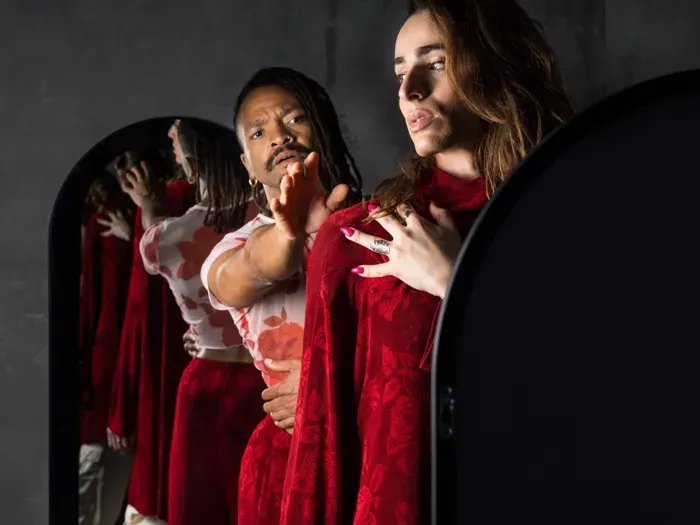
Four years later, Anyanwu’s gripping experimental piece is being mounted again, in its second production ever, by Crowded Fire Theater at Z Space from April 24-May 3.
“It’s interesting for me to see another group of artists pick up this play and find resonance in it now,” said the Nigerian-born New York-based Anyanwu in a recent interview with the Bay Area Reporter.
“We may not be in the midst of a pandemic, but the arts are still under siege. It feels like we’re approaching a fascist regime, if we’re not already in it. The theater industry is feeling leaner and more held back.”
Sociopolitical constriction, Anyanwu suggests, can make artists feel as cut off as a quarantine. And in the current moment, that can especially true for queer artists like director Naila Harper-Malveaux and the gender-expansive cast of the Crowded Fire production.
Defining a relationship
On its surface, “The Last of the Love Letters” can easily be interpreted as an interpersonal romance in a dystopian world; its two primary characters seen as ex-lovers torn and still circling each other in a combination of rage, regret, and horny rapaciousness.
The blast-force 75-minute performance sets their monologues in opposition, then tangles them. It hits with the blended wallop of Kafka, Orwell, and Ntozake Shange.
But with Anyanwu’s lyrical dialogue and dystopian setting, she challenges audiences to think of this couple less literally. Not as he/she or they/they, but as artist/art.
“I’ve always thought of the relationship between an artist and their art as being like a couple,” she said. “Sometimes the relationship is toxic. Sometimes you just want to stop doing it, but it has a hold on you, and you can’t. Sometimes you feel like it’s left you. I always go into writing a play with a question I’d like to answer. I don’t necessarily come out having answered it. But maybe in the process of producing, or performing, or seeing the play, someone else will.”