

For many gay men of the baby boom generation, a Damron travel guide is a touchstone of personal history.
It’s the book that led them to their first gay bar, or helped them plan their most memorable vacation, or just let them know where it was safe to be themselves. It debuted five years before Stonewall, thrived in the era of gay liberation, persevered through the height of the AIDS epidemic, and carried on into a new century, Damron also transcends the personal: It’s an icon of gay American history.
Yet while copies of long out-of-print editions sell for multiples of their original prices online, and a smattering of academics have begun to recognize the scholarly value of the Damron guides, their social impact remains widely unrecognized. Gina Gatta hopes that will change: “The guide was a real institution in gay life. It should never be forgotten.”
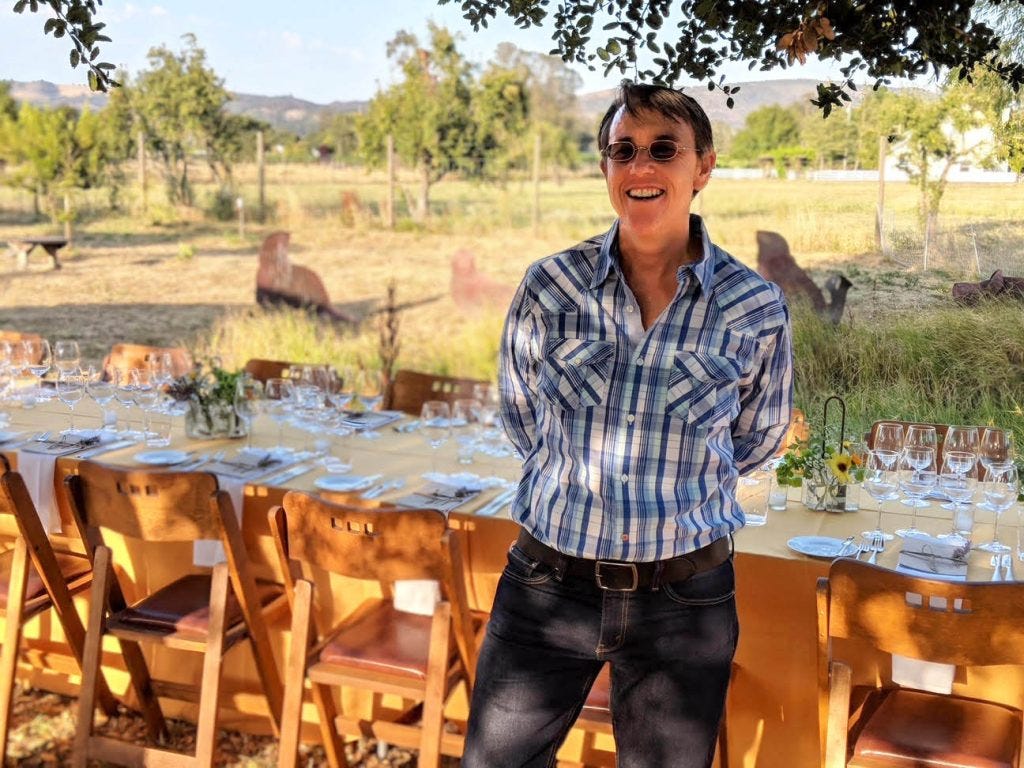
Gatta, the owner of Damron, Inc., published the guide for 23 of its 52 years, through the final edition in 2019. Since then, Gatta has donated archival materials to several universities and historical societies. She’s also had nibbles of interest from filmmakers who see potential in the Damron story, whether as a feature akin to Oscar winner The Green Book, a documentary, or a limited series for television.
But Gatta, 62, whose devotion to Damron is palpable, won’t rush into any project without careful consideration. In the early days of the internet, she turned down lucrative offers from online entrepreneurs who wanted to buy Damron, concerned that they might not prove respectful stewards of the brand. “Some people might say I blew it,” she commented in a recent interview, acknowledging that she had passed up deals that would have left her in a better financial situation today, “But it was never really about getting the most money. I had a lot to be proud of. Damron is a big part of my identity. It’s a great American company. People who worked for me will tell you it’s the best job they ever had. They were paid well, I set them up with 401Ks and health insurance. There was a sense of being in a community of people who really took care of each other.”
Gatta and her Damron team also prided themselves on extending support to the wider gay community. “We sold a lot of books direct to customers, so we ended up having a toll free number in them. Back in the 80s and 90s, guys ended up calling that sales line saying they were going to kill themselves, guys who felt so isolated or depressed because they were gay. And whoever answered the phone, we would talk them down, give them information on how to find help where they lived, just let them know they weren’t alone.”
“We also got letters thanking us for the book, telling us what a difference it made in their lives. I even remember getting one from a mother who bought a guide to give her son.”
How Gatta, a lesbian, ended up as the owner, caretaker, and guardian angel of Damron is a story worth telling. But another story needs to come first.
ROAD SCHOLAR
In 1964, 36-year-old San Francisco bar owner Bob Damron set out on a series of car trips through the United States and Canada, notebook in hand. Visiting over 200 cities, the brawny, mustachioed road warrior sought out bars, restaurants, hotels, bath houses, cruising areas and other locations frequented by gay men.
While a few of these venues had come to Damron’s attention before he got rolling, significant portions of his itineraries evolved on the fly. With homosexual activity illegal in 49 states and gay newspapers a big city rarity at the time, the businesses Damron visited survived largely on whispered word-of-mouth.
Patrons of one spot would let Damron know about other gay gathering places in the vicinity, leading him from the likes of the Kismet Grill in Columbus, Ohio, to the Robin Hood in Akron, to the Coral Bar in Cleveland.
Supplementing his in-person research with postal correspondence and long-distance phone calls—an expensive proposition at the time, Damron ultimately identified the 758 gay venues that he listed in the 1965 debut edition of The Address Book. (The final guide, published in 2019, included over 10,000 listings).
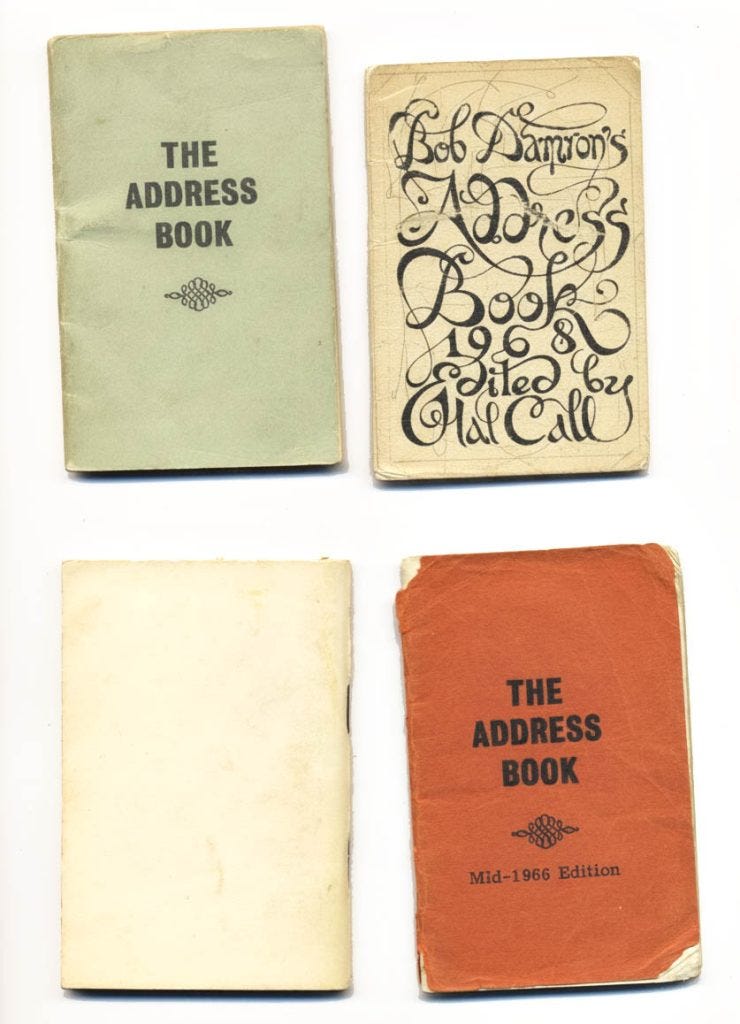
Later years’ editions were published as Bob Damron’s Address Bookand the Damron Men’s Travel Guide; but regardless of official titles, readers generally referred to them all as “Damron guides.”

DISCOVERING COMMUNITY
From its initial print run of 1,500, the Damron guide became the atlas of a previously hidden country. Sold by mail-order and at some of the businesses that appeared in their listings, the books provided street addresses of establishments that often had no signage or other exterior identification. (At the time, most gay businesses were unwilling to have their phone numbers appear in print, fearing a deluge of harassing calls).
Some academics have likened the Damron Guides to the “Negro Motorist Green Book” series, published annually from 1936 to 1966 to help Black travelers navigate Jim Crow America and find places to eat, sleep, shop, and vacation with their families in peace and safety.
But flipping through Damron’s pages did more than help gay roadtrippers, business travelers and truckers find welcoming places to congregate. It helped others recognize that they were not alone, that they had compatriots from coast-to-coast. Even for gay men who rarely ventured beyond their hometowns, a Damron guide could provide a sense of potential, a map of possibility.
Beyond the few big cities where displaying colored bandanas or other mutually understood visual totems could discreetly communicate one’s homosexuality, it was difficult for gay men to even recognize each other. Damron guides undermined this invisibility, helping plant seeds of community by pointing likeminded men toward each other.
COVERS AND CONTENT
Attuned to the needs of their audience, Damron guides were models of discretion. “The original books were 3” x 2” and had less than 100 pages printed on very thin paper, like in a bible,” explained Gina Gatta.“You could tuck them in your pocket, and no one was the wiser. The covers were bland, on purpose. Just a solid color, the year, and ‘Bob Damron’s Address’ book. The Damron name didn’t mean anything to anyone other than gay guys.”
“If you were traveling, you could throw a book in your suitcase or the glove compartment of your car; it wasn’t going to stand out to a cop, a luggage inspector, or someone you were sharing a room with. “Early on, the books didn’t say ‘gay’ anywhere,” Gatta explained. “That could get you hassled. It could also get businesses that were listed in trouble. I didn’t put ‘gay’ on the covers until 1999.”
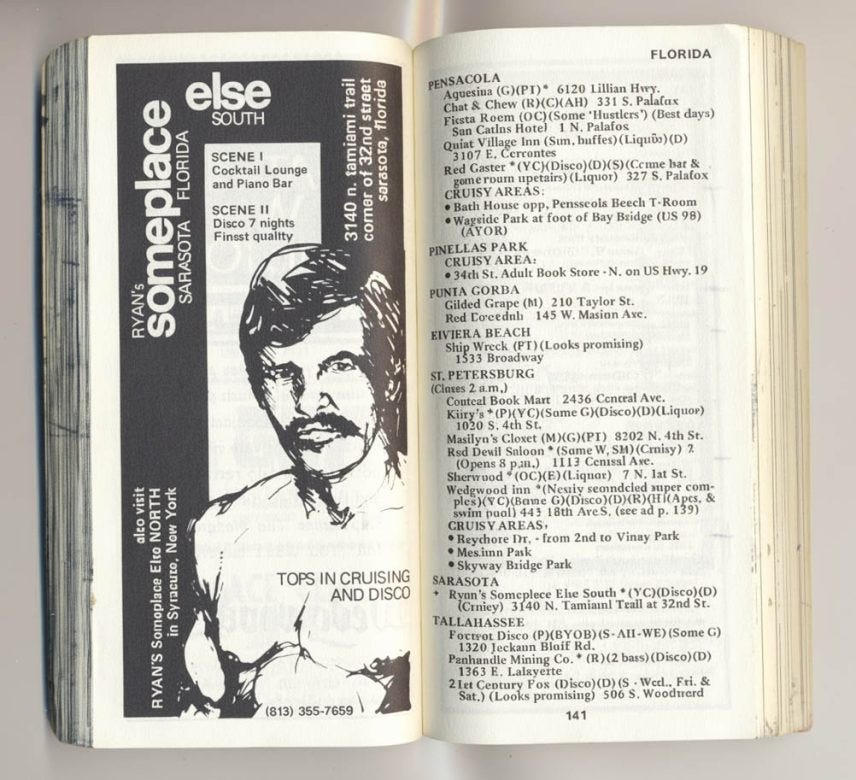
The interior pages of the Damron guides published prior to the mid-1970s were spare, simple text listings organized alphabetically, by state, city, and venue name. Alabama always came first, and even way back in 1965, the Damron guide could point you to dick in the Heart of Dixie: Eight addresses were listed across Birmingham, Mobile, and Montgomery.
An “Explanation of Listings” page at the front of each book provided a key to the simple codes that accompanied each address, providing a bare bones description of the venue: Dindicated “Dancing,” W meant you’d find “Western or cowboy types,” PE signalled “Pretty Elegant-Jacket & Tie may be required,” and YC meant “Young/Collegiate types.”
While some of the more straightforward codes remained constant throughout the years, others were removed or added over time. Occasionally, they were coy or cryptic: SM, explained as “Some motorcycle and leather,” may have merited a bit more precision; and FFA is explained as “Final Faith in America, or ask your friendly SM serviceman.”
Cruising areas like parks, beaches, highway rest stops, and public restrooms were often coded with the unfortunately ambiguous HOT, explained as “Dangerous, usually fuzz.” Eventually, HOT was replaced with AYOR for “At Your Own Risk,” which briefly became a gay signifier in the 1990s, printed on gym- and club-wear. When asked about Damron, some gay Boomers and older Millennials instinctively mention AYOR.
BULKING UP
Bob Damron never charged businesses to be included in the guides, remaining committed to his original goal of having the books’ listings be as comprehensive and accurate as possible. Road trips soon became an insufficient means of data collection. A notice in each book encouraged customers to write in with news of gay venue openings and closures, and to help identify any errors in the current listings.
When compiling a new volume, editors and assistants called every establishment included in the prior edition to make sure they were still in operation, and to inquire about any changes to listings’ accompanying letter codes. This meant placing thousands of long-distance landline calls. In the 1970s, a three minute call cost around 70 cents (the equivalent of over $4.30 today). Until the early 2000s, well after Gina Gatta took charge of the company, this was by far the costliest element of Damron, Inc.’s overhead.
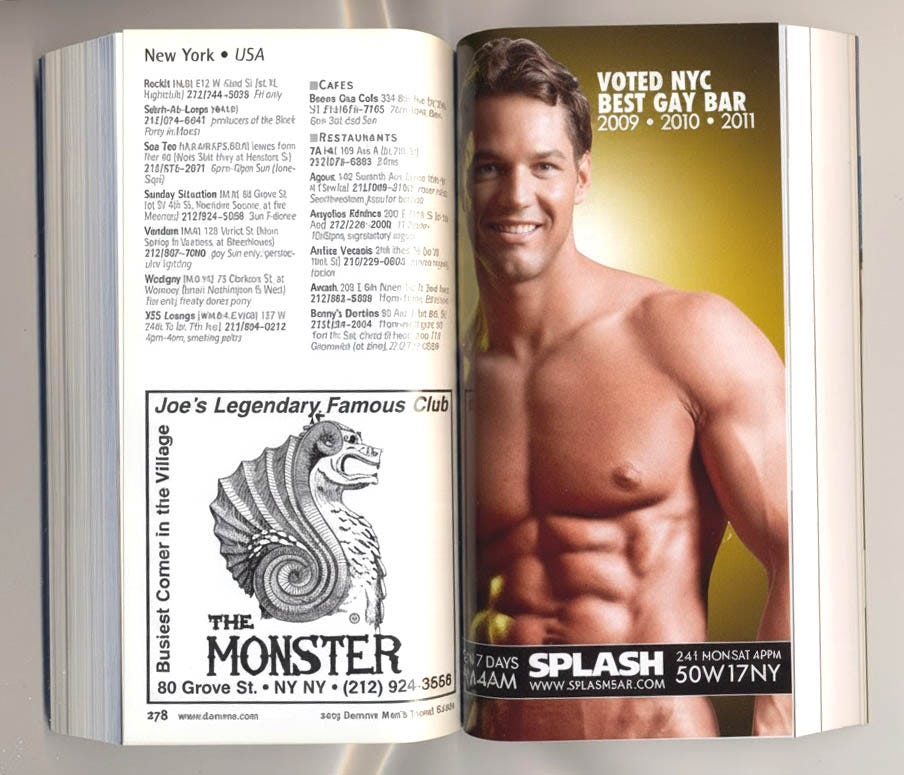
By 1976, with gay culture emerging from the closet with a new brazenness, Damron decided to add display advertising to the guides, selling space adjacent to each state’s listings to local businesses, and later placing national ads, often for mail-order items and periodicals, in their own sections toward the front and back of the books. While incorporating advertising introduced extra tasks and complexity to an already laborious paste-up production process (For more than two decades, Damron guides were produced without desktop publishing), it also led to increased profits and expanded page counts.
The small pop-and-pop businesses that bought space in the guides often wrote and designed their own amateur advertisements, lending the books a quirky, sometimes titillating new charm: “If you’re breathing and your body’s warm…you’re our kind of people,” read the 1979 ad for Los Angeles’ Melrose Baths. A Dallas bar’s 1982 ad extended a grammatically perplexing invitation to “Come see what’s hidden behind THE HIDDEN DOOR.”
Cartoonish line drawings of men with swollen pecs and bulbous butts proliferated, as did grainily reproduced photos of guys in the leather jackets, tight jeans, and Mark Spitz mustaches that constituted the “clone” look fashionable at the time.
With their added visual appeal, the now chunky guides (Is that a Damron in your pocket, or are you just happy to see me?) became statement pieces and conversation starters, signifiers of proud membership in a growing gay tribe. By the mid-1980s, new Damron editions were selling over 20,000 copies.
But the boom in business and the gay community’s increasing self-acceptance painfully coincided with the advent of the AIDS epidemic. In 1985, at the height of his creation’s success, Bob Damron unexpectedly announced that he was selling the company to a close friend, Dan Delbex, and taking an early retirement at age 57. (Damron died of AIDS a few years later).
FRIENDS AND FAMILY
Gina Gatta moved to San Francisco from her native Rhode Island in 1983, at 19. Like so many queer young people before her, she arrived in the city both excited and uncertain about her future. Short and wiry, with a gregarious, tomboyish mien, Gatta had grown up admiring her brothers, Bruce and Ed. Seven and nine years her senior, both were gay. “I think I scared my big brothers,” recalled Gatta, who was more open in her queerness, almost by default, “I was confusing to them.”
“I’ve always looked like a boy, but I never wanted to transition. I like being a girl, and I like hang out with gay guys. It used to make my brothers really uncomfortable when we were in public and someone mistook me for a boy or called me ‘sir.’ They’d get really defensive. Did they feel protective? Embarrassed? I didn’t know.”
Since she arrived in San Francisco more than four decades ago, Gatta has carved a path forward that simultaneously embodies her resolute sense of self, her compassion for the queer community, and a strong, abiding connection to her brothers.
During her first few years in the city, Gatta threw herself into queer nightlife, even as the whirlwind of AIDS touched down, and cobbled together a living with multiple part time jobs. “In 1987, I got a gig as a plant tech,” said Gatta. “The company sent me around to offices to take care of their plants.” Among the stops on her watering rounds was the headquarters of Damron, Inc. at 10th and Folsom, luxuriously decorated and exuding success. There, Gatta was thrilled to reaccquaint herself with Dan Delbex. The charismatic, creative friend of Bob Damron who had purchased and taken over the company was an ex of Gatta’s brother Ed. “Dan and Ed had been together for a few years in the late ‘70s,” Gatta recalled, “But there was no bad blood between them after they split. While they were dating, Dan was friendly with our whole family.”
Delbex and Gatta got along wonderfully upon reconnecting “He felt like family, and he knew he could trust me,” she said. Delbex took Gatta under his wing, first bringing her on part-time to help with chores around the office and by 1989 hiring her as a full time employee.
“I was the mail-order girl,” recalled Gatta, “But I started to learn the business and do a little of everything.” Delbex had ambitiously pushed the company forward, adding a lesbian travel guide to Damron’s offerings and initiating plans to further expand the publishing portfolio with men’s guides to individual cities, including international gay hot spots. Still in her early twenties, Gatta was impressed with the success of her brother’s former beau and thrilled to be a part of it.
Delbex moved Damron’s printing to a company in China, adding full color pages to accomodate glossy photographic ads which could sell at a premium. He oversaw beach and poolside photo shoots for the increasing number of men’s hotels in Fort Lauderdale, Palm Springs, and Key West, often inviting his wide-eyed, hard partying protége to tag along. But Gatta gradually allowed herself to see the cracks in Delbex’s high-flying façade.
“Dan was in total denial,” she recalled. “He was HIV-positive and completely denying it.” Repressing reality and resisting medical care, Delbex dedicated himself to the idealized lifestyle of leisure and pleasure depicted in the Damron guides.
His health rapidly deteriorated after returning from a final, blow-out European vacation in 1991. In his final months, Gatta was frequently joined at Delbex’s bedside by her brother Ed, by then a successful businessman and philanthropist based in Portland, Oregon.
SURVIVAL AND SUCCESS
When Delbex died, Ed Gatta was among the trustees assigned to his affairs. He quickly discovered that Damron, Inc. was far from the thriving enterprise his sister had come to believe it was. Unpaid printing bills of $300,000 and other debt left the company over a million dollars in the red. For the next five years, Damron, Inc. remained in trusteeship, and a flurry of reorganizations driven by conservative external directors.
As outside managers and consultants rotated through, Gina Gatta remained aboard throughout, overseeing the day-to-day business of keeping the Damron guide afloat. She also initiated some changes of her own, bolstering the book’s listings with AIDS organizations, counseling services, and other non-profit organizations essential to queer communities.
By 1996, the trust had managed the company’s debt and began to pursue its sale, but Gatta had other plans. With an assist from her brother, she was able to take ownership of Damron, Inc. and continue to publish for over two more decades, ultimately running the company for more years than Bob Damron himself.
The late 1990s proved Damron’s most successful era. As the epidemic receded and the gay community grew more visible and self-assured, Damron guides sold as many as 50,000 copies a year, making their way to the shelves of national bookstore chains including Borders and Barnes & Noble.
Even during these boom years, Gatta kept the company lean with just four employees on staff. Never drawing more than a five figure salary herself, Gatta saw Damron as her life’s mission, a labor of love.
As early as 1997, when AOL began hosting gay chat rooms, Gatta took small steps toward moving Damron online, but ultimately, they were to little avail. (A sporadically updated website remains at damron.com, underwritten by a trickle of vintage guide sales).
“We were built on listings,” Gatta acknowledged. “Our information wasn’t proprietary, anyone could copy it. And they did.” Hit hard by the 2008 financial crisis and the ongoing rise of digital media, the writing was on the wall for Damron. With fewer sales and thinner margins with each new edition, Gatta, who ran the business entirely on her own for its final few years, made the decision to cease publication with the Damron guides 52nd edition in 2019.
THE DAMRON LEGACY
While there may be little need for a new Damron guide, vintage editions-and the information they contain-are invaluable. Eric Gonzaba, Ph.D., a professor of American Studies at California State University in Fullerton is one of the directors of the “Mapping the Gay Guides” project which was launched in 2020 with funding from the National Endowment for the Humanities.
“Mapping the Gay Guides” (mappingthegayguides.org) is digitizing and geolocating the data from Damron guides to support historical studies of the growth and geographic movement of gay communities in the United States
“The Damron guides are a national treasure,” said Gonzaba, “As is Gina Gatta.”