Hedwig Robinson, née Hansel Schmidt, had their biological business cut short, but there’s been no shortage of “Hedwig and the Angry Inch” on Bay Area stages in recent years.
Between its celebration of gritty genderqueerness, its glorious punk-pop score by Stephen Trask (Think Green Day meets Bowie), and a cast of two, plus band, which makes for an economical musical, it’s no surprise that the show is frequently produced here.
The latest iteration, now at the New Conservatory Theatre Center (NCTC) through June 7, is a double-barreled take, featuring two distinctly different actors, Trixxie Carr and Samuel Del Rosario, alternating in the roles of Hedwig and their browbeaten husband, Yitzhak, from performance to performance.
Polished production values
Before parsing differences between these two variations, let’s note this production’s many praiseworthy consistent elements. First and foremost is the four-piece on-stage “Angry Inch” band, expertly led by music director Jake Gale on keyboards.
Gale, frequently seen in principal acting roles (Once at Berkeley Playhouse; Cruel Intentions and Kinky Boots at Ray of Light), is visibly engaged with his vocal and instrumental collaborators throughout the show, using head and hands to shape their attack.
Guitarist Diogo Zavazdaki, drummer Bea “Libby” Cuffie, and bassist Stephen Bollinger (three bass players will rotate through the duration of the production), and Gale ace the crunch and snarl of the score with what feels like freewheeling aggression but is impeccably timed to align with Carr and Del Rosario’s singing.
Not a syllable of Trask’s nuanced lyrics gets stepped on or lost to amplification, a frequent problem in productions of this show, which try to walk a line between rock club and musical theater, with varying degrees of success.
Sound engineer Brittany Cobb shares responsibility for this version’s impressive aural finesse, which led to lyrics being so crisp and clear that some audience members could be spotted mouthing along to every word.
Opening and closing film clips by projection designer Stephen Hitchcock effectively ground the show in San Francisco, as do a few choice quips about NCTC and the Easter-eggy repurposing of a set-piece from the company’s once regularly-revived production of “Avenue Q” ( A few fleeting moments may go over the heads of non-habitual NCTC-goers, but regulars should feel flattered by the dramaturgical perks).
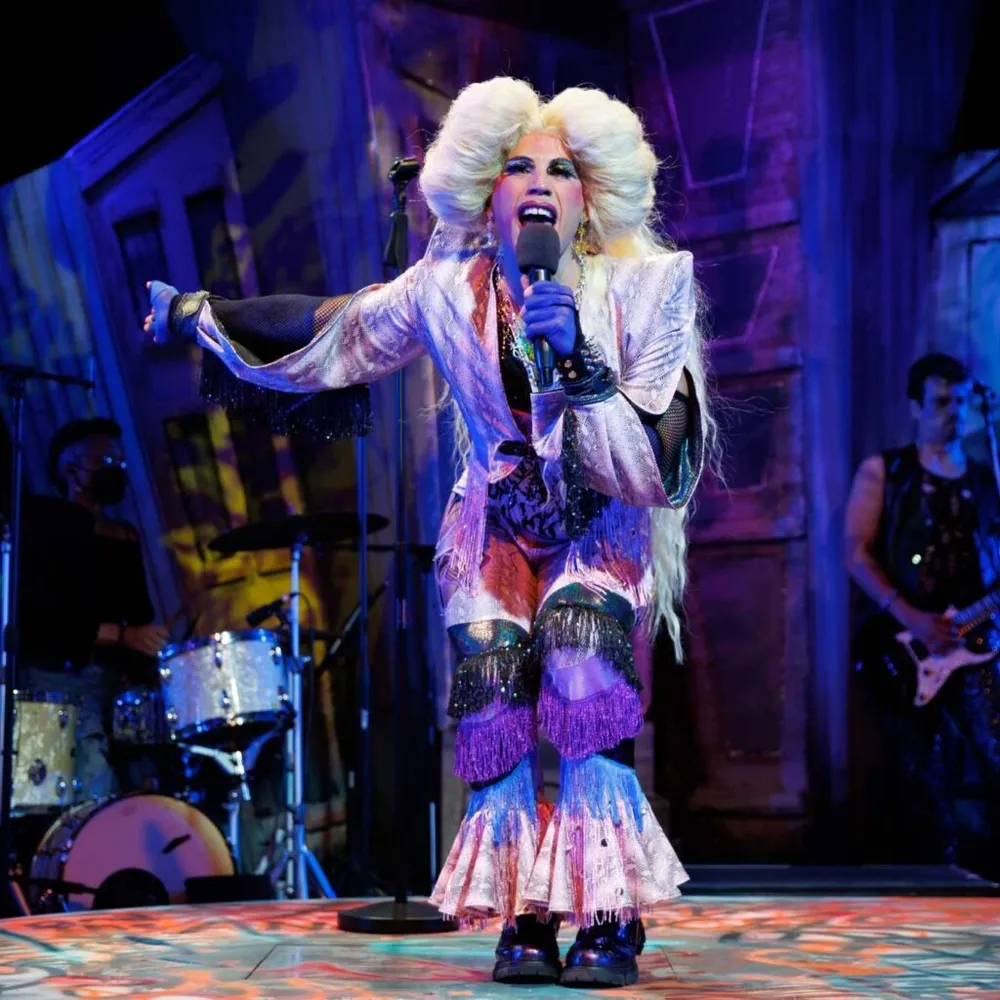
Matt Owens’ set design has some nifty surprises in store, Chris Steele’s costumes feel like sex and violence in wearable form, and, with director Chris Morrell, Dave Haaz-Baroque has developed a simple-but-elegant passage of shadow puppetry that nods to an animation sequence in the show’s movie version.
Wig designers Laundra Time and Wigs by Tips face the gauntlet of a show whose celebrated songs include “Wig in a Box” and soar beyond Hedwig’s requisite lung-like dual tufts with a second hirsute monument that calls to mind a helium-pumped hybrid of Tina Turner and Dolly Parton.
Gender loving care
None of this first-rate stagecraft would amount to much without genuinely mesmerizing Hedwigs up front. Carr and Del Rosario both Deliver.
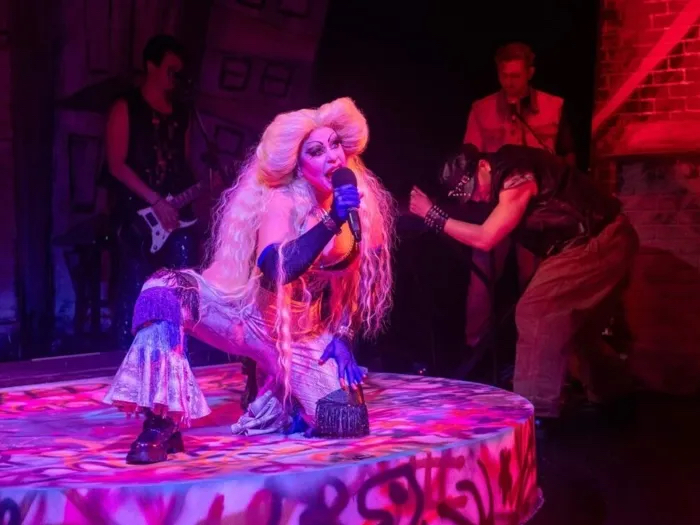
Carr’s take on the traumatized survivor of Communist Germany and genital mutilation has an earthy, seen-it-all, blues-inflected swagger. She’s a wisecracker, but oh-so-tired, with a dollop of Janis Joplin and a dash of Ruth Brown in her Hedwig vocals.
When performing as Yitzhak, complete with dusky five o’clock shadow, Carr convincingly boils under Hedwig’s thumb, occasionally upstaging and undermining her with an emotional cocktail of venom and condescension.
Del Rosario’s turn as Yitzhak is the least successful of the duo’s four performances. His lithe, natural sexiness which makes sense when he plays Hedwig doesn’t get sufficiently tamped down in his Yitzhak, who writhes, poses and pulls like one of the Sprockets guys from pleistocene-era SNL.
Only in this version’s emotionally rich finale, when Carr transfers the signature Hedwig headwear to Yitzhak, does Del Rosario click fully into this character, his eyes filling with grateful tears as Yitzhak re-assumes the mantle of his long-denied drag divadom.
It’s a whole different story when Del Rosario plays Hedwig. His muscled limbs and chest serve as a constant reminder of the character’s cis-male origins; both to the audience and, no doubt, to Hedwig herself.
Even while making light of life’s indignities by putting on a bitchy, camp facade, there’s always a wounded young Hansel at the heart of this Hedwig.
When Del Rosario’s Hedwig removes his wig and offers it to Carr’s Yitzhak, we again see his eyes well up. And we see another character realign with their innermost essence.
He falls to his knees, bares his impressive pecs, and sings to the heavens, seizing “a slip of a girly boy”’s right to joyful life.