
Food, glorious food.
“The Lunchbox,” a richly satisfying new musical now in a world premiere production at Berkeley Repertory Theatre, is stacked with delicious vittles and vivid ditties.
From the fantasy banquet in “Oliver!” to the clambake reverie of “Carousel”; from the feast of “miso soups” and “meatless balls” in “Rent”’s “La Vie Boheme,” to the heaping helping of “Corn Puddin’” served up in the Tony-anointed “Schmigadoon!”, combo-plates of culinary evocation and heartfelt composition have helped bring soul-nourishing power to many a musical.
Built around the 135-year-old Mumbai tradition of dabbawallahs traveling by foot and bicycle to bring tiffins (multi-tiered metal containers) of fresh-cooked food from mothers and wives at home to men at their workplaces (and then return the empties for re-use the next day), “The Lunchbox” delivers with all the charm and unlikely efficiency of its milieu.
Simple romance, social insight

Ritesh Batra’s book, based on his 2013 screenplay for the critically admired film, is, at its simplest level, a gently simmering love story. Ila, played with limpid emotion by Kuhoo Verma, is stuck in a passion-depleted marriage. Fernandes is a longtime widower whose brusque shell hides a witty inner romantic.
The plot hinges on an ongoing fairytale coincidence that makes “The Lunchbox” feel like a better fit for the inherent artifice of the stage than the photorealism of its film version.
Trying to rekindle her connection with her husband, Ila slips an affectionate note into the tiffin of homemade delicacies she sends his way each day. A rare glitch in the dabbawallah system finds her lovingly-prepared lunch mistakenly delivered to Fernandes. The food is marvelous, a gustatory oasis in the midst of his humdrum paper-pushing workday. He slips a kind thank you note into the emptied tiffin (“He licked it clean!” exults Ila, before realizing that it’s a foreign tongue making her feel so good).
Thus begins an ever wittier and wiser epistolary relationship. It’s completely dependent on the same error being repeated on a daily basis. This is a musical though, so we swallow it with a spoonful of sugar.
“The Lunchbox” celebrates the expressive love languages of home cooking and written correspondence. It hits with particular poignance at this moment when we nod our heads when we’re told our world suffers from an epidemic of loneliness. Ila and Fernandes are heroes for taking the risk of reaching out, of being open to connecting with strangers rather than continuing to settle for melancholy lives of Good Enough.
There’s a secondary plot that obliquely touches on another related contemporary American social ill; the lack of strong adult male friendships.
Fernandes, initially resistant to the professional and platonic personal overtures of his optimistic underling, Shaikh (Aathaven Tharmarajah, an absolute delight), gradually agrees to mentor, and then inevitably befriends, him. The aborning avuncular relationship is surprisingly touching.
It’s worth noting though, that in India, and much of the world, strong male friendships are much less fraught than in our toxic country. Watch the warm, unselfconscious physical contact between the dabbawallahs as they go about their work (and their dancing). Their casual affection registers not as straight or queer, but as pure.
Multisensory embrace
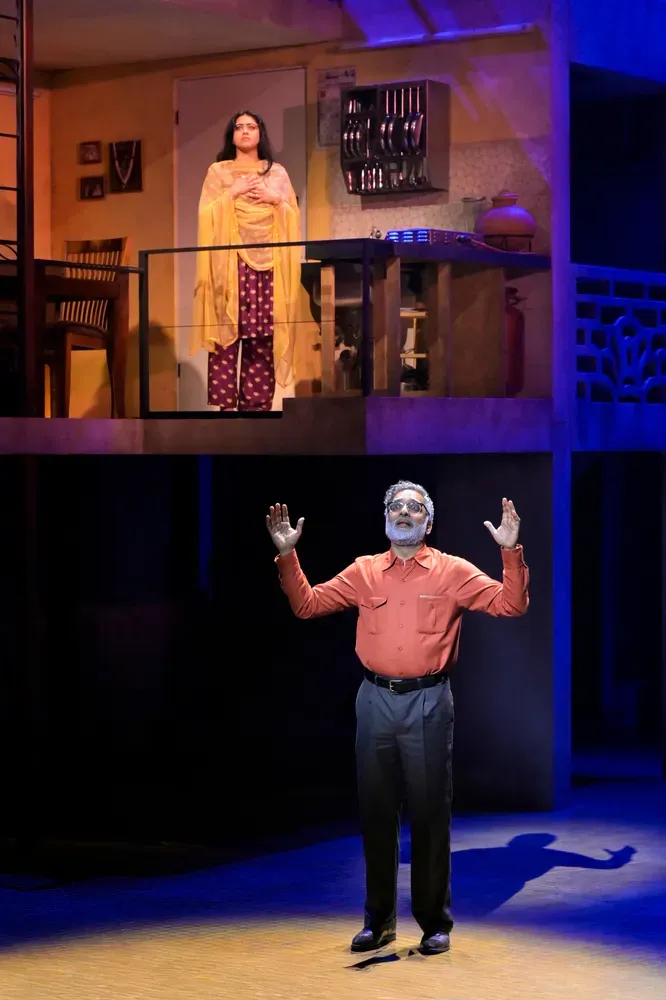
Along with a handful of centerpiece song-and-dance numbers, the score, by brothers Daniel and Patrick Lazour; choreography, by Reshma Gajjar—a well-balanced blend of folk, street, Broadway, and Bollywood styles; and direction by Rachel Chavkin (“Hadestown”) keep the stage in a state of city busy-ness with near constant snippets of rhythm, melody and motion.
The terrific instrumental ensemble is cleverly placed within the apartment block set, making the players part of the city’s anonymous crowds. One percussionist is tucked in a stage-level alcove, sitting cross-legged like a busker, ignored by passersby.
Costumes by Arjun Bhasin and lighting by Bradley King give us vivid colors, but as seen through the dusty scrim of underprivileged urban life.
Like the savory aromas and flavors suggested by lyrics and dialogue that rhapsodize over dishes of eggplant, mutton, apples, and cauliflower; evanescent lines of music waft from the stage into the audience.
Performers and onlookers are drawn together, collectively immersed in a multisensory stew of mundanity and magic.
There’s the effective occasional jolt of strong spice (one dish is cheekily described as incorporating enough chilies to “burn a hole through his hole”; one moment of agony disrupts the wry, self-protective acceptance of life’s vagaries that prevails among Batra’s characters), but overall “The Lunchbox” provides warm, welcoming envelopment.